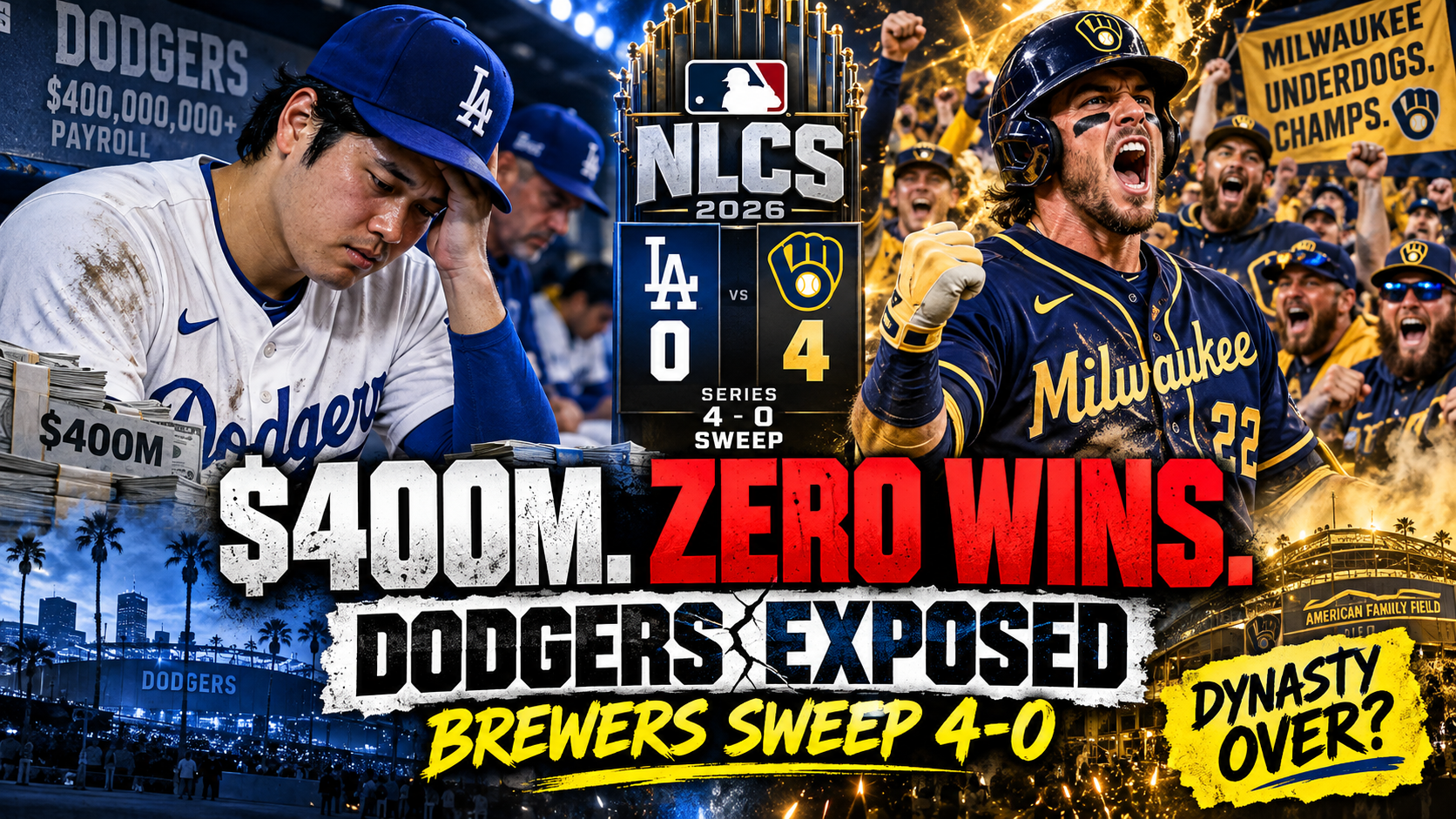
Dodgers Swept 4-0: $400M Payroll, Zero NLCS Wins
The Los Angeles Dodgers spent approximately $400 million on their 2026 player payroll. The Milwaukee Brewers spent roughly $131 million. Yet Milwaukee swept Los Angeles 4 to 0 in the National League Championship Series, ending the Dodgers' attempt to win a third consecutive World Series. Shohei Ohtani struggled for much of October, LA's expensive lineup failed repeatedly with runners in scoring position, and a four run lead in Game 4 still wasn't enough.
Four hundred million dollars.
Zero wins in the National League Championship Series.
And one extremely expensive October vacation.
The Los Angeles Dodgers entered the 2026 postseason chasing something historic. After winning consecutive World Series championships in 2024 and 2025, they had an opportunity to become baseball's first threepeat champion since the New York Yankees won three straight titles from 1998 through 2000.
Instead, the Milwaukee Brewers sent them home in four games.
Not seven. Not six. Not even five.
Four.
And the worst part for Dodgers fans? Milwaukee didn't steal the series with one lucky home run.
The Brewers beat Los Angeles in four consecutive games, repeatedly punished mistakes and then erased a four run deficit in the decisive Game 4.
The Dodgers had the bigger payroll, the bigger stars and the championship reputation.
Milwaukee had the better baseball team when it mattered.
So let's talk about what all that money actually bought.
1. A $400 Million Payroll and Not One NLCS Victory
According to FanGraphs' 2026 Dodgers payroll data, Los Angeles carried an estimated player payroll of approximately $400 million.
The Milwaukee Brewers' estimated payroll was around $131 million.
Let's put those figures next to the results.
| Category | Dodgers | Brewers |
|---|---|---|
| Estimated 2026 player payroll | $400 million | $131 million |
| Estimated luxury tax payroll | $409.4 million | $141.1 million |
| Regular season wins | 100 | 103 |
| NLCS victories | 0 | 4 |
| World Series qualification | No | Yes |
The Dodgers spent roughly $269 million more on their estimated player payroll.
Milwaukee won three more regular season games and four more NLCS games.
Now, payroll alone is not a perfect measure of organizational success. Contracts are signed over multiple seasons, deferred compensation complicates accounting, and the Dodgers already won championships in 2024 and 2025.
Those championships matter.
But so does what happened this year.
A team spending around three times as much as its opponent just got swept.
And if that doesn't deserve criticism, what does?
The argument isn't that spending money is bad.
It's that spending this much money creates expectations.
And the Dodgers didn't come remotely close to meeting them in the NLCS.
2. The Dodgers Paid for Superstars and Got an October Offense That Couldn't Hit
Here is the statistic that should make every Dodgers fan uncomfortable.
Los Angeles finished the NLCS with just five hits in 43 at bats with runners in scoring position.
That's a .116 batting average in the situations where getting a hit could have driven in runs.
Five for 43.
This wasn't a roster of unknown rookies overwhelmed by the biggest stage.
This was a lineup featuring Shohei Ohtani, Mookie Betts, Freddie Freeman and other established major league hitters.
Milwaukee's pitching deserves enormous credit, but the Dodgers cannot hide behind the quality of their opponent.
The Dodgers' Game 4 breakdown from True Blue LA documents just how badly the offense struggled to turn opportunities into runs.
A lineup can have a superstar at nearly every important position and still fail if those players cannot produce at the same time.
That's what happened here.
The Dodgers were built to overwhelm opponents with talent.
Milwaukee made them look ordinary.
And by the end of the series, it was impossible to pretend this was simply one unfortunate night.
3. The $700 Million Shohei Ohtani Question Nobody Wants to Answer
Shohei Ohtani signed a ten year, $700 million contract with the Dodgers.
That remains one of the most extraordinary commitments in sports.
To be clear, the headline contract value is not his actual cash payment for 2026. Most of the money is deferred, and the contract is treated differently for payroll and competitive balance tax purposes.
But none of those accounting details change the expectations placed on a player of his stature.
And for much of this postseason, Ohtani fell well short of them.
According to Reuters' report on Ohtani's postseason struggles, he entered the final game hitting .174 in October without an extra base hit or an RBI.
The Dodgers had built their identity around one of baseball's most extraordinary talents.
Yet when their season began unraveling, Ohtani could not consistently provide the offensive production they needed.
Yes, he was dealing with injuries to his right biceps and left knee.
Those injuries are relevant. They should not be ignored.
He also produced an important moment in Game 4.
Ohtani launched a three run home run that helped Los Angeles take a 4 to 0 lead.
It was exactly the kind of superstar moment Dodgers fans had been waiting for.
And Milwaukee still won 6 to 4.
That makes the story even more painful for Los Angeles.
The one night Ohtani finally delivered a dramatic home run, the rest of the team couldn't protect the lead.
The roast isn't that Ohtani suddenly became a bad player. It's that the Dodgers assembled a roster built around superstar production and still looked helpless when those stars couldn't carry the team.
Ohtani remains an extraordinary talent.
His postseason deserves criticism without pretending otherwise.
Both can be true.
4. The Funniest Part? Milwaukee Didn't Need a $400 Million Roster
Milwaukee's NLCS MVP was Jake Bauers.
Not a player with a $700 million contract.
Not a global marketing phenomenon.
Jake Bauers.
He drove in six runs during the four game series and delivered several of its most important plate appearances.
In Game 3, Bauers worked an 11 pitch at bat against Blake Snell before hitting a two run home run.
In Game 4, he delivered a two run double and later drew a bases loaded walk that tied the game.
These weren't random contributions.
They were examples of a player executing under pressure.
The Dodgers had the more expensive collection of stars.
The Brewers had a hitter willing to make an elite pitcher work for 11 pitches and then punish his mistake.
Milwaukee also received crucial production from Garrett Mitchell, David Hamilton, Jackson Chourio and its bullpen.
That is what made the contrast so brutal.
The Dodgers were supposed to have the talent advantage everywhere.
Milwaukee kept finding the better answer.
And that raises an uncomfortable question for a franchise spending approximately $400 million.
If a team with roughly one third of your payroll can develop, organize and deploy its talent this effectively, what exactly is your financial advantage buying you in October?
It buys opportunities.
It doesn't buy execution.
Milwaukee proved that emphatically.
5. The Dodgers Were Up 4-0 in an Elimination Game. Somehow, They Still Lost.
If you're looking for the moment that summarizes the entire Dodgers postseason, it's Game 4.
Los Angeles entered the night trailing the series 3 to 0.
One more defeat would end its attempt to become the first MLB team in a quarter century to win three straight championships.
So what happened?
The Dodgers finally came out swinging.
Shohei Ohtani hit a three run homer.
Los Angeles built a 4 to 0 lead.
Tyler Glasnow retired Milwaukee's first ten hitters.
For a moment, the Dodgers looked like the team everyone had expected to see.
Then they completely lost control.
Jake Bauers cut the lead in half with a two run double.
Milwaukee kept putting runners on base.
David Hamilton contributed an important RBI single.
The Brewers tied the game through a bases loaded walk.
Garrett Mitchell homered in the sixth inning to put Milwaukee ahead.
Hamilton added an insurance home run in the ninth.
And Aaron Ashby recorded the final nine outs to send the Brewers to the World Series.
The official Associated Press account of the Brewers' historic sweep details how Milwaukee completed the comeback.
The Dodgers had four runs, home field advantage and their season on the line.
They still couldn't finish the game.
At some point, you have to stop calling every failure bad luck.
Watch the Dodgers' Game 4 Collapse
The official MLB Brewers vs Dodgers Game 4 highlights show the four run Dodgers lead, Milwaukee's comeback, Garrett Mitchell's decisive home run and the final outs of the series.
Watch how quickly the momentum changes once the Brewers begin forcing Los Angeles to make difficult pitches with runners on base.
For a more detailed breakdown, read our Brewers vs Dodgers Game 1 analysis, which examined the early warning signs that ultimately defined the series.
6. Dave Roberts Deserves Questions. But This Failure Is Bigger Than One Manager.
Whenever an expensive team loses, fans immediately look for someone to blame.
The manager is usually first.
Dave Roberts will face plenty of scrutiny after this series.
And some of it is justified.
The Dodgers struggled to convert scoring opportunities. Their pitching staff repeatedly failed to finish important innings. The bullpen could not protect the four run lead in Game 4.
Roberts is responsible for the decisions that shape how his team responds.
But here's what makes blaming him for everything intellectually lazy.
A manager cannot hit with runners in scoring position for his players.
He cannot physically throw strikes for his relievers.
He cannot make every expensive superstar perform like an MVP.
The bigger issue is that Los Angeles assembled a roster with exceptional individual talent but failed to translate that talent into collective postseason performance.
That responsibility extends beyond the manager.
It involves roster construction, player development, injuries, preparation and execution.
The Dodgers have been extremely successful under Roberts.
Two consecutive World Series championships are evidence of that.
But success in previous seasons does not make this year's collapse acceptable.
The correct criticism is not that Roberts has never been good enough.
It's that the Dodgers were nowhere near good enough when the NLCS demanded their best baseball.
7. Milwaukee Exposed the Difference Between Buying Talent and Building a Team
There is a popular belief in professional sports that spending more money should eventually solve almost every problem.
Need pitching?
Spend.
Need power?
Spend.
Need another established star?
Spend again.
Los Angeles has been remarkably effective at acquiring talent.
But a huge payroll doesn't guarantee that an entire roster will function well under pressure.
Milwaukee provided an alternative.
The Brewers finished the regular season with 103 wins, the most in MLB.
They entered October as a legitimate contender, not a lucky outsider.
Their success came from a combination of productive development, smart roster construction, pitching depth and players fulfilling their roles.
Aaron Ashby's three inning save in Game 4 captured that identity perfectly.
The Dodgers couldn't score when they needed to.
Milwaukee found someone who could secure the final nine outs.
As the Reuters report on Milwaukee's World Series qualification explains, the Brewers' collective execution helped deliver their first World Series appearance since 1982.
Their smaller payroll does not prove that spending is irrelevant.
Wealthy teams still have structural advantages in acquiring and retaining talent.
But Milwaukee proved that those advantages are not enough by themselves.
Especially in October.
8. Is the Dodgers Dynasty Over?
Now comes the biggest question.
Is this the end of the Dodgers dynasty?
The dramatic answer is yes.
The more defensible answer is that the Dodgers' attempt at a historic third consecutive championship is over, but the franchise's competitive window is not necessarily closed.
They still have an exceptionally talented roster.
They still have financial resources that most teams cannot match.
They still have Shohei Ohtani.
And they have already demonstrated an ability to win championships.
One playoff sweep cannot erase two World Series titles.
But it can expose legitimate weaknesses.
The Dodgers' offense was too inconsistent.
Their pitching failed to protect key advantages.
Their stars did not collectively perform at the level required to defeat Milwaukee.
And their extraordinary payroll did not prevent a four game elimination.
Calling the dynasty permanently dead would be premature.
Calling the 2026 postseason a humiliating failure is entirely reasonable.
The distinction matters.
A great organization can suffer a disastrous postseason.
What determines its future is how effectively it responds.
9. What $400 Million Couldn't Buy
The Dodgers could afford some of baseball's most expensive players.
They could assemble a star filled lineup.
They could enter the postseason as two time defending champions.
What they couldn't buy was a hit with runners in scoring position when they desperately needed one.
They couldn't buy a clean inning when Milwaukee kept putting pressure on their pitchers.
And they couldn't buy one single victory in the National League Championship Series.
Meanwhile, the Brewers kept doing the things that championship contenders are supposed to do.
They found ways to score.
They protected difficult situations.
They received contributions throughout the lineup.
They adapted when their pitchers struggled.
And they won every game.
Baseball's payroll imbalance remains an important issue.
But this series offered an important reminder.
A wealthy organization can build an enormous competitive advantage.
It still has to play the games.
Milwaukee did that better.
Four times.
Final Verdict: The Most Expensive Embarrassment of October?
The Dodgers spent approximately $400 million on player payroll in 2026.
They entered the season chasing a historic third consecutive World Series championship.
They had Shohei Ohtani, Mookie Betts, Freddie Freeman and a roster filled with established talent.
Then the Milwaukee Brewers swept them.
Four games.
Zero wins.
A blown four run lead in the elimination game.
And a season that ended before the World Series even began.
This was not evidence that Ohtani is overrated or that the Dodgers' previous championships were meaningless.
It was evidence that the best roster on paper doesn't always become the best team on the field.
Milwaukee earned the pennant.
Los Angeles earned the criticism.
The Dodgers bought almost everything money could buy. The Brewers showed them the one thing money couldn't guarantee.
Four wins when they mattered.
Frequently Asked Questions
Did the Dodgers get swept in the 2026 NLCS?
Yes. The Milwaukee Brewers defeated the Los Angeles Dodgers in four consecutive games to win the 2026 National League Championship Series 4 to 0.
How much did the Dodgers spend on their 2026 roster?
FanGraphs estimated the Dodgers' 2026 player payroll at approximately $400 million, with an estimated luxury tax payroll of about $409.4 million. These are different accounting measures.
How much was the Brewers' 2026 payroll?
FanGraphs estimated Milwaukee's player payroll at approximately $131 million and its luxury tax payroll at around $141.1 million.
How did Shohei Ohtani perform in the 2026 playoffs?
Ohtani struggled offensively for much of the postseason, entering NLCS Game 4 with a .174 playoff batting average. He hit a three run homer in the elimination game, but the Dodgers lost 6 to 4.
Why did the Dodgers lose to the Brewers?
Milwaukee received stronger timely hitting, effective bullpen performances and important contributions from throughout its roster. Los Angeles hit just .116 with runners in scoring position during the series.
Did Shohei Ohtani's $700 million contract hurt the Dodgers?
Ohtani's contract is a ten year agreement with extensive deferred payments. Its headline value should not be confused with the Dodgers' annual cash payroll or luxury tax calculation. One postseason slump does not establish whether the full contract provides good value.
Is the Dodgers dynasty over?
Their attempt to win three consecutive World Series titles ended in 2026. However, the Dodgers remain a well funded franchise with elite talent, so it is too early to conclude that their wider championship window has closed.
Who won the 2026 NLCS MVP?
Milwaukee's Jake Bauers won the award after delivering several crucial hits and driving in six runs across the four game sweep.
Done reading? Your turn.
Think you know Baseball? Settle it.
AI builds a fresh quiz on any topic, you play it against the community and climb the leaderboard. Free, no download.
Play free in 10 seconds → 3 min read
What Is AI Sports Trivia and How Does It Work?
AI sports trivia is a quiz where the questions are written by AI instead of pulled from a fixed list. Here is how it works, why the questions rarely repeat, and how to play NFL trivia free on Spontyx.
 13 min read
Brewers vs Dodgers Game 4 Highlights: LA's Collapse
The Milwaukee Brewers beat the Los Angeles Dodgers 6 to 4 in NLCS Game 4 on October 15, 2026, completing a four game sweep and advancing to their first World Series since 1982.…
 10 min read
Brewers vs Dodgers Game 4: Is LA's Dynasty Finished?
The Los Angeles Dodgers face elimination against the Milwaukee Brewers in Game 4 of the 2026 NLCS on October 15. Milwaukee leads the series 3 to 0 after winning Game 3 by a score…