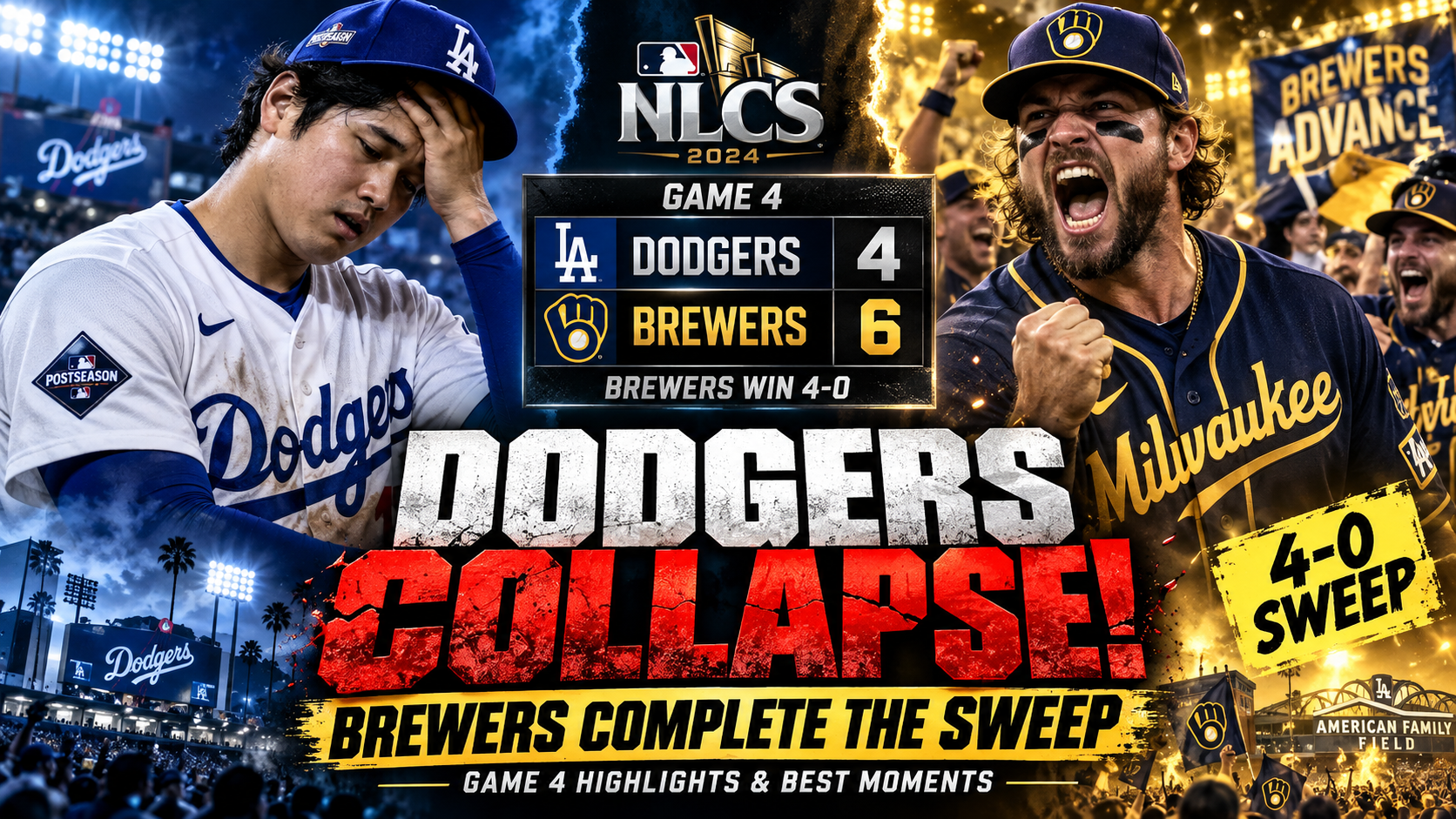
Brewers vs Dodgers Game 4 Highlights: LA's Collapse
The Milwaukee Brewers beat the Los Angeles Dodgers 6 to 4 in NLCS Game 4 on October 15, 2026, completing a four game sweep and advancing to their first World Series since 1982. Milwaukee erased a 4 to 0 deficit, Garrett Mitchell hit the winning home run, Jake Bauers earned NLCS MVP honors, and Aaron Ashby recorded the final nine outs. Here are the biggest moments and why the Dodgers' season ended despite Shohei Ohtani's dramatic three run homer.
For a little while, Dodger Stadium believed.
Shohei Ohtani finally broke out of his postseason slump. Los Angeles scored four early runs. Tyler Glasnow retired the first 10 Milwaukee hitters he faced.
Everything seemed to be pointing toward a Game 5.
And then the Dodgers lost control.
Milwaukee scored six consecutive runs, turned a four run deficit into a historic comeback and celebrated the National League pennant on the same field where its 2025 season had ended.
The final score was 6 to 4.
But that number doesn't fully capture what happened.
The Dodgers had the early lead, the superstar moment and a genuine opportunity to extend their season. What they didn't have was an answer when Milwaukee started applying pressure.
The most uncomfortable conclusion for Los Angeles is that even when Ohtani delivered, the Brewers still found a way to win.
Brewers vs Dodgers Game 4: Final Score and Key Facts
| Game detail | Result |
|---|---|
| Final score | Brewers 6, Dodgers 4 |
| Date | October 15, 2026 |
| Venue | Dodger Stadium, Los Angeles |
| Series result | Brewers win NLCS 4 to 0 |
| Winning pitcher | JoJo Romero |
| Save | Aaron Ashby |
| Winning home run | Garrett Mitchell, sixth inning |
| NLCS MVP | Jake Bauers |
| Next for Milwaukee | World Series, beginning October 23 |
Milwaukee became the first MLB team to sweep a best of seven postseason series after trailing in all four games.
Even more remarkably, the Brewers reversed the exact result of the previous postseason, when the Dodgers swept them in the 2025 NLCS.
The official MLB report on Milwaukee's historic pennant explains why this victory means so much to a franchise that had waited 44 years to return to the World Series.
Watch: Brewers vs Dodgers Game 4 Full Highlights
The official MLB Game 4 highlights capture the Dodgers' early advantage, Milwaukee's comeback, Garrett Mitchell's home run and the final outs that secured the National League pennant.
Watch Brewers vs Dodgers NLCS Game 4 full highlights on YouTube
You can also watch the official MLB Game 4 highlight recap, a shorter video covering the decisive scoring plays and Milwaukee's celebration.
The story of Game 4 is best understood through six moments.
1. Shohei Ohtani Finally Delivered. The Dodgers Still Lost.
The first major moment belonged to Los Angeles.
Andy Pages drove in the opening run with an RBI single in the second inning.
Then Shohei Ohtani stepped to the plate.
The four time MVP had struggled to produce his usual offensive numbers throughout the postseason. With the Dodgers facing elimination, the pressure surrounding his performance had become impossible to ignore.
This time, he delivered.
Ohtani launched a three run home run, sending Dodger Stadium into a frenzy and giving Los Angeles a 4 to 0 advantage.
For a moment, the narrative appeared ready to change.
Ohtani had finally provided the explosive offensive performance the Dodgers desperately needed.
But one spectacular swing could not protect a four run lead for the remaining seven innings.
Milwaukee didn't panic.
And Los Angeles never scored again.
The Associated Press account of Ohtani's home run and the Dodgers' elimination captures the contrast between the early celebration and the final outcome.
The controversial takeaway: Ohtani's performance makes the Dodgers' defeat more revealing, not less.
It demonstrates that the problem was never simply one superstar failing to produce.
Los Angeles needed its pitching, defense and entire lineup to protect the advantage.
They couldn't.
2. Jake Bauers Turned a Comfortable Dodgers Lead Into a Real Game
Tyler Glasnow looked dominant at the beginning.
He retired Milwaukee's first 10 hitters, striking out six of them.
The Brewers had fallen behind 4 to 0 and appeared unable to generate any meaningful offensive pressure.
Then everything changed in the fourth inning.
Brice Turang drew a walk.
William Contreras followed with a ground rule double.
Jake Bauers then delivered a two run ground rule double that cut the Dodgers' lead in half.
Suddenly, a game that had looked comfortable was 4 to 2.
That sequence mattered because Milwaukee did not need a home run to get back into the contest.
The Brewers created a baserunner, followed with an extra base hit and turned the opportunity into runs.
They made Glasnow work.
And after cruising through the first three innings, the Dodgers' starter suddenly had a difficult game to manage.
Bauers would go on to become the NLCS MVP, finishing the four game series with six RBIs.
His performance was an example of why this Milwaukee team was so difficult to eliminate.
The Brewers didn't rely on one superstar to deliver every important moment.
Different players contributed when the opportunity arrived.
The Reuters recap of the series clinching victory documents how Bauers helped drive Milwaukee's comeback.
3. The Fifth Inning Was Where the Dodgers Really Lost Control
The most damaging sequence of Game 4 wasn't necessarily the winning home run.
It was the fifth inning.
Los Angeles still led 4 to 2.
The Dodgers had an opportunity to limit Milwaukee's rally and maintain control of an elimination game.
Instead, the Brewers found ways to reach base and force increasingly difficult pitching decisions.
Sal Frelick walked and stole second.
David Hamilton delivered an RBI single that reduced the deficit to one run and ended Glasnow's outing.
The Dodgers turned to Alex Vesia.
But the pitching change did not solve the problem.
Vesia walked Brice Turang and William Contreras, loading the bases.
Then he walked Jake Bauers with two outs.
Hamilton scored.
The game was tied 4 to 4.
Milwaukee had erased the entire Dodgers lead without needing a fifth inning home run.
That is what makes the sequence so revealing.
A four run advantage had disappeared because Los Angeles could not consistently prevent baserunners or finish important plate appearances.
Milwaukee stole bases, took walks and forced the Dodgers to keep executing under pressure.
The Dodgers couldn't.
It would be too simple to blame the entire inning on Dave Roberts.
Managers cannot physically throw strikes for their relievers.
But the result still raises legitimate questions about Los Angeles' pitching depth and ability to handle pressure.
The fifth inning was the turning point that made Garrett Mitchell's winning home run possible.
The Dodgers were no longer protecting a comfortable lead.
They were fighting to keep their season alive.
4. Garrett Mitchell Delivered the Home Run That Ended LA's Momentum
The sixth inning produced the game's defining swing.
The score was tied 4 to 4.
Garrett Mitchell stepped in against Tanner Scott.
He fell behind in the count, no balls and two strikes.
Scott then threw three consecutive balls, bringing the count full.
Mitchell had survived the disadvantage.
On the next pitch, he launched a 409 foot solo home run to center field.
Milwaukee led 5 to 4.
For the first time all night, the Brewers were ahead.
The home run was Mitchell's second in consecutive NLCS games.
It also marked the first home run of his career after falling behind in an 0 and 2 count.
Think about what that means in the context of this game.
The Dodgers had led 4 to 0.
Their starting pitcher had been nearly untouchable early.
Ohtani had given them the offensive moment everyone was waiting for.
And now they were losing.
Mitchell's home run was important because it completed a comeback, but it also represented the larger pattern of this series.
When Milwaukee faced difficult situations, its hitters kept competing.
When the Dodgers faced pressure, they repeatedly failed to secure the outs they needed.
The official MLB NLCS video collection includes Mitchell's home run and other individual highlights from the deciding game.
5. Aaron Ashby Shut the Door When the Dodgers Still Had Opportunities
Milwaukee led by one run.
But the game was not over.
The Dodgers still had chances to tie the score.
And this is where Aaron Ashby became one of the night's most important players.
Ashby entered in the seventh inning and ultimately recorded the final nine outs.
Three innings.
No runs allowed.
A save that sent the Brewers to the World Series.
It was not a completely stress free appearance.
In the seventh, Los Angeles had a runner on third with one out.
Ashby struck out Ohtani swinging.
Mookie Betts then grounded out to end the inning.
In the eighth, Will Smith doubled and reached third after a defensive error.
Again, Los Angeles had an opportunity.
Again, Milwaukee prevented the tying run from scoring.
Ashby got Kyle Tucker to fly out and struck out Teoscar Hernández.
The Dodgers had reached dangerous positions but couldn't produce the hit that would change the game.
Ashby gave Los Angeles opportunities to respond.
He did not give them runs.
That distinction matters.
Milwaukee's bullpen was not simply overpowering hitters in situations without pressure.
It was executing while the Dodgers had real opportunities to tie the game.
The official MLB Game 4 highlights show how Ashby's final innings protected Milwaukee's narrow lead.
This was not only a story about offensive heroics.
It was also a story about relief pitching that repeatedly delivered when it mattered.
6. David Hamilton Added the Final Blow
By the ninth inning, the Dodgers were running out of opportunities.
Milwaukee still had a one run advantage.
Then David Hamilton stepped to the plate against Edwin Díaz.
Hamilton was hardly the most obvious candidate to deliver a decisive postseason home run.
He had hit just four during the regular season.
But playoff baseball doesn't always follow the expectations created by regular season numbers.
Hamilton launched a two out solo home run.
Milwaukee led 6 to 4.
The Brewers now had an extra run of protection for the bottom of the ninth.
Ashby completed the job.
And the celebration began.
Hamilton's home run did not provide the winning run. Mitchell had already done that.
Its importance was different.
It transformed a one run game into a two run game at the moment Milwaukee was preparing to finish its most important victory in decades.
The Dodgers needed another comeback.
They never produced one.
7. Did the Dodgers Choke, or Were the Brewers Simply Better?
The word collapse will dominate coverage of this game.
It is understandable.
Los Angeles led 4 to 0.
It lost 6 to 4.
Its season ended in a four game sweep.
But calling the Dodgers' performance a collapse without acknowledging Milwaukee's execution would be incomplete.
The Brewers did not wait for six gifted runs.
They earned important walks, delivered doubles, stole bases, hit home runs and repeatedly escaped difficult defensive situations.
The Dodgers contributed to their own defeat through missed opportunities and pitching problems.
Milwaukee actively exploited those weaknesses.
Both things happened.
There is also a broader historical context.
The Dodgers entered the NLCS attempting to win their third consecutive World Series championship.
Milwaukee entered seeking revenge after Los Angeles swept it in the 2025 NLCS.
This year, the result was reversed.
The Brewers became the first team in MLB history to sweep an opponent that had swept them in the previous postseason.
They also became the first team to sweep a best of seven postseason series after trailing in every game.
Those are extraordinary achievements.
The MLB report on the historic NLCS sweep provides the full historical context.
So were the Dodgers overrated?
That is too broad a conclusion for a team that won 100 regular season games and entered the playoffs as a two time defending champion.
But the series exposed a difference between having an exceptionally talented roster and delivering under postseason pressure.
For four consecutive games, Milwaukee performed better when it needed to.
That is not something the Dodgers can explain away with one unlucky inning.
8. What Milwaukee's World Series Run Means
The Brewers are returning to the World Series for the first time since 1982.
They finished the regular season with 103 victories, the most in Major League Baseball.
They have now eliminated the Dodgers, the team that had repeatedly stood between Milwaukee and a deeper postseason run.
But the most important lesson may be how the Brewers won.
Their lineup produced timely offense from several different players.
Their pitching staff recovered when individual pitchers struggled.
Their defense and baserunning contributed to the pressure they placed on Los Angeles.
And their bullpen protected close games against some of baseball's most recognizable hitters.
That combination makes Milwaukee a serious championship contender.
It does not guarantee a World Series victory.
The Brewers will still need to adjust to a new opponent and manage their pitching staff through another demanding series.
But after beating the defending champions four consecutive times, there is no reason to describe Milwaukee as a team simply enjoying a lucky postseason.
The Brewers have earned their place.
Game 1 of the World Series is scheduled for October 23 in Milwaukee. Their opponent will be the winner of the Cleveland Guardians and Tampa Bay Rays ALCS.
Final Verdict: Ohtani Delivered the Highlight. Milwaukee Won the Game.
If you watched only the second inning, you might have believed the Dodgers were about to begin a historic comeback.
Ohtani homered.
Los Angeles led by four.
Glasnow looked dominant.
Everything suggested that Game 4 might belong to the defending champions.
But postseason baseball is not decided by the most spectacular moment.
It is decided by the final score.
Milwaukee erased the deficit through disciplined plate appearances, timely hitting and the ability to respond to adversity.
Bauers helped start the comeback.
Hamilton brought Milwaukee within one run and later added an insurance homer.
Mitchell delivered the winning swing.
Ashby recorded the final nine outs.
And the Brewers celebrated a National League pennant 44 years in the making.
The Dodgers had the biggest star and the early lead. Milwaukee had the better finish, the better series and ultimately the pennant.
That is what Game 4 revealed.
Frequently Asked Questions
Who won Brewers vs Dodgers Game 4 in the 2026 NLCS?
The Milwaukee Brewers defeated the Los Angeles Dodgers 6 to 4 on October 15, 2026, completing a 4 to 0 NLCS sweep.
What were the best moments of Brewers vs Dodgers Game 4?
The biggest highlights included Shohei Ohtani's three run home run, Jake Bauers' two run double, Milwaukee's game tying fifth inning, Garrett Mitchell's winning sixth inning home run, David Hamilton's ninth inning homer and Aaron Ashby's nine out save.
Who hit the winning home run in Game 4?
Garrett Mitchell hit a solo home run off Tanner Scott in the sixth inning, giving Milwaukee a 5 to 4 lead.
Did Shohei Ohtani hit a home run in Game 4?
Yes. Ohtani hit a three run home run in the second inning, helping the Dodgers build a 4 to 0 lead.
Who won the 2026 NLCS MVP award?
Jake Bauers won the NLCS MVP award after driving in six runs across the four game series.
Who earned the save in Game 4?
Aaron Ashby recorded a three inning save, getting the final nine outs without allowing a run.
Are the Los Angeles Dodgers eliminated?
Yes. The Brewers swept the Dodgers in four games, ending Los Angeles' attempt to win a third consecutive World Series title.
When is the 2026 World Series?
Game 1 is scheduled for October 23, 2026, with Milwaukee hosting the winner of the American League Championship Series.
Done reading? Your turn.
Think you know Baseball? Settle it.
AI builds a fresh quiz on any topic, you play it against the community and climb the leaderboard. Free, no download.
Play free in 10 seconds → 3 min read
What Is AI Sports Trivia and How Does It Work?
AI sports trivia is a quiz where the questions are written by AI instead of pulled from a fixed list. Here is how it works, why the questions rarely repeat, and how to play NFL trivia free on Spontyx.
 13 min read
Dodgers Swept 4-0: $400M Payroll, Zero NLCS Wins
The Los Angeles Dodgers spent approximately $400 million on their 2026 player payroll. The Milwaukee Brewers spent roughly $131 million. Yet Milwaukee swept Los Angeles 4 to 0 in…
 10 min read
Brewers vs Dodgers Game 4: Is LA's Dynasty Finished?
The Los Angeles Dodgers face elimination against the Milwaukee Brewers in Game 4 of the 2026 NLCS on October 15. Milwaukee leads the series 3 to 0 after winning Game 3 by a score…