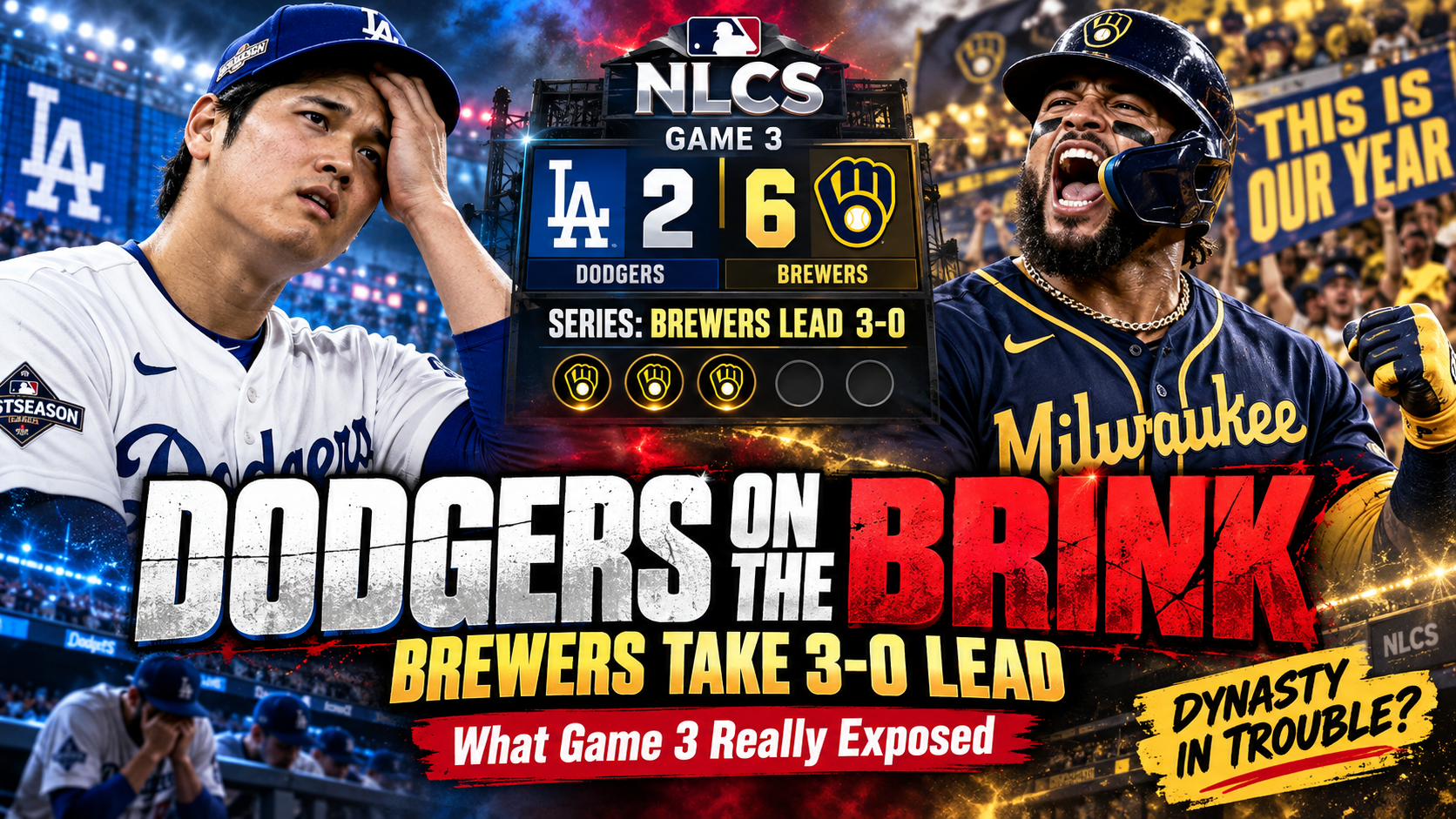
Brewers vs Dodgers Game 3: Is LA's Dynasty Collapsing?
Brewers vs Dodgers Game 3: Is LA's Dynasty Collapsing?
The Milwaukee Brewers defeated the Los Angeles Dodgers 6 to 2 in Game 3 of the 2026 NLCS on October 14, taking a commanding 3 to 0 series lead. Jake Bauers delivered the decisive two run home run in the seventh inning, Garrett Mitchell followed with another homer, and rookie Robert Gasser pitched five scoreless innings. Now the defending champions are one loss away from elimination.
Three games. Three losses.
And perhaps the most uncomfortable part for the Los Angeles Dodgers is that Milwaukee no longer looks like the underdog.
The Brewers have repeatedly found ways to punish Los Angeles in the moments that matter most. They have survived dangerous situations, received outstanding pitching and forced the Dodgers to work desperately for runs.
For a franchise attempting to win a third consecutive World Series title, that's a serious problem.
But Game 3 raised an even bigger question.
Are the Dodgers losing because their stars are underperforming, or because Milwaukee has become the better postseason team?
The answer may be more uncomfortable than either explanation on its own.
Garrett Mitchell homered immediately afterward.
You can review the complete scoring sequence in the official MLB Game 3 box score and play by play.
1. Jake Bauers Exposed the Difference Between Talent and Execution
There was nothing particularly comfortable about Jake Bauers' seventh inning plate appearance.
Milwaukee trailed 2 to 1.
Blake Snell had recovered after allowing Jackson Chourio's opening home run and retired 14 consecutive batters during one stretch.
The Dodgers finally had a lead.
Dodger Stadium was alive.
Then Andrew Vaughn walked.
Christian Yelich entered as a pinch runner, and Bauers stepped into the batter's box.
What followed may become the defining plate appearance of Milwaukee's postseason.
Bauers saw 11 pitches.
He fouled off pitch after pitch, refusing to chase his way into an easy out.
Finally, Snell delivered a fastball over the plate.
Bauers sent it into the right field stands.
Milwaukee led 3 to 2.
One batter later, Garrett Mitchell hit another home run.
Just like that, the Dodgers went from leading a crucial playoff game to trailing 4 to 2.
The significance of Bauers' at bat goes beyond the home run.
In Game 2, he had already worked a 12 pitch walk that helped create a scoring opportunity.
Against elite pitching, extending an at bat can have enormous value. It increases the pitcher's workload, creates opportunities for mistakes and forces an opponent to execute repeatedly under pressure.
Bauers didn't need the reputation of an MVP.
He needed one excellent plate appearance.
And he delivered it when Milwaukee needed it most.
2. The Dodgers Finally Took the Lead and Immediately Lost It
For five innings, Los Angeles struggled against Robert Gasser.
The Brewers rookie allowed just three hits and one walk while keeping the Dodgers scoreless.
But the sixth inning appeared to change everything.
Milwaukee replaced Gasser with Abner Uribe.
Uribe struggled with his command, walking three Dodgers and allowing Los Angeles to load the bases.
Will Smith then drove a two run double off the wall in left center field.
The Dodgers led 2 to 1.
For the first time in the game, Los Angeles looked capable of taking control.
The problem was what happened next.
DL Hall entered the game and struck out Enrique Hernández and Tommy Edman, preventing the Dodgers from adding to their lead.
That sequence was enormous.
Los Angeles had created a rare opportunity against Milwaukee's pitching staff. A bigger inning could have forced the Brewers to chase multiple runs against Snell.
Instead, the Dodgers settled for two.
Milwaukee immediately responded with three runs in the seventh.
This is becoming a recurring theme throughout the series.
The Dodgers generate opportunities.
The Brewers prevent those opportunities from becoming decisive.
Then Milwaukee punishes the next mistake.
In its official Game 3 analysis, MLB highlighted Milwaukee's remarkable ability to respond immediately after conceding runs.
That pattern suggests something more meaningful than a team simply enjoying a fortunate stretch.
The Brewers are demonstrating an ability to recover psychologically and tactically when games begin moving against them.
It doesn't mean every future comeback is guaranteed.
It means the Dodgers have repeatedly failed to finish the job after creating an advantage.
3. Shohei Ohtani's Batting Order Demotion Wasn't the Real Problem
Dave Roberts made one of the most notable lineup decisions of the postseason before Game 3.
Shohei Ohtani was moved to sixth in the Dodgers' batting order.
For a player with his reputation, that was an extraordinary adjustment.
The decision followed an extended offensive slump.
Ohtani entered Game 3 with only three singles in 20 postseason at bats, while injuries to his right biceps and left knee had complicated his season.
The Reuters report on Ohtani's batting order change detailed both his struggles and Roberts' attempts to adjust the lineup.
Ohtani finished Game 3 with one hit in two official at bats, a walk and a hit by pitch.
He reached base three times.
That's not the kind of performance that should make him the obvious target for every criticism directed at Los Angeles.
And that is precisely why the conversation needs to change.
Moving Ohtani down the lineup can alter the distribution of plate appearances and the situations in which he bats.
It cannot automatically repair an offense that has struggled throughout the series.
Los Angeles recorded only five hits in Game 3 after collecting three in Game 2.
Those are team problems.
Not simply Ohtani problems.
The controversial question isn't whether Roberts should have demoted Ohtani. It's whether changing the batting order was ever going to address the Dodgers' deeper offensive weaknesses.
A superstar can become an easy explanation for a struggling team.
But Los Angeles has too many established hitters for one player's slump to explain everything.
The Dodgers need more than a lineup adjustment.
They need better offensive execution throughout the order.
4. Blake Snell Didn't Pitch a Bad Game. He Lost the Most Important Battle.
Blake Snell's final pitching line was not disastrous.
He worked into the seventh inning, struck out nine batters and held the Brewers to one run through six innings.
After Chourio attacked his first pitch for a leadoff home run, Snell settled down impressively.
He retired 14 consecutive hitters at one point.
For much of the evening, he was exactly the pitcher Los Angeles needed.
But playoff baseball can be brutally unforgiving.
One extended plate appearance changed everything.
The seventh inning began with Vaughn's walk.
Bauers followed with the decisive home run.
Mitchell added another.
Snell exited with four earned runs allowed.
That is why traditional pitching statistics can sometimes provide an incomplete picture of postseason performances.
Snell generated strikeouts.
He controlled Milwaukee for a substantial part of the game.
But he couldn't complete the seventh inning without surrendering the lead.
There is an important difference between saying a pitcher performed poorly and saying he failed in the decisive moment.
Snell fits the second description much better.
The Reuters Game 3 recap documented his strong middle innings and the costly final sequence.
The Dodgers will have more important questions to answer than simply blaming their starting pitcher.
Snell gave Los Angeles a legitimate opportunity to win.
His offense didn't build a comfortable lead, and Milwaukee punished the mistake that followed.
5. Milwaukee's Bullpen Has Become the Biggest Difference in This Series
The Brewers' bullpen has been outstanding throughout the NLCS.
Game 3 offered another example of why.
Uribe struggled in the sixth inning, surrendering the lead after walking three hitters.
That could have been the beginning of a complete collapse.
Instead, DL Hall entered with two runners still in scoring position.
He struck out the next two batters.
Those outs prevented further damage and kept Milwaukee within one run.
Hall ultimately delivered 2 1/3 scoreless innings.
Trevor Megill then recorded the final four outs for his fourth postseason save.
That is the kind of pitching depth that changes playoff series.
Not every reliever will perform perfectly.
Not every pitching change will work immediately.
What matters is whether a team has enough effective options to recover when one pitcher struggles.
Milwaukee has repeatedly shown that ability.
The Dodgers, meanwhile, have struggled to generate sustained offense against the variety of pitchers Milwaukee can deploy.
The Brewers have different arms, different approaches and enough flexibility to avoid relying entirely on one dominant starter.
This is particularly important in October, when managers often remove starting pitchers earlier than they would during the regular season.
A strong bullpen can turn a narrow lead into a victory.
An exceptionally well managed bullpen can also prevent a temporary setback from deciding the game.
That is exactly what happened in Game 3.
6. Jackson Chourio Needed Only One Pitch to Make a Statement
Before Bauers delivered the decisive home run, Jackson Chourio made an immediate impact.
On the first pitch of the game, Chourio drove a Blake Snell fastball over the opposite field fence.
Milwaukee led 1 to 0.
It was an extraordinary start, particularly against a pitcher of Snell's quality.
According to MLB's official Game 3 report, Chourio became just the sixth hitter since complete pitch count tracking began in 1988 to homer on the first pitch of a postseason game.
The significance was both tactical and psychological.
Snell had barely begun his outing before he was trailing.
The Brewers had announced that they were prepared to attack early rather than waiting passively for their opportunities.
That approach is particularly interesting because Milwaukee finished the regular season last in the National League in home runs.
The Brewers were not built around a lineup of traditional power hitters.
Yet in Game 3, three home runs became central to their victory.
That doesn't mean Milwaukee has suddenly transformed into one of baseball's most powerful teams.
It means the Brewers are finding different ways to win.
And opponents cannot assume that limiting their usual offensive strengths will necessarily be enough.
7. Are the Dodgers Being Outplayed or Outmanaged?
This is where the debate becomes uncomfortable.
Los Angeles entered the series with an extraordinary collection of established stars.
Shohei Ohtani.
Mookie Betts.
Freddie Freeman.
Blake Snell.
A roster filled with players capable of deciding games individually.
Milwaukee does not need to match that reputation.
The Brewers have instead relied on collective execution, productive plate appearances and a pitching staff capable of protecting difficult situations.
Through three games, that approach has been more effective.
But does that automatically mean Dave Roberts is being outmanaged?
Not necessarily.
Managers cannot control whether a pitcher misses his intended location on the 11th pitch of a demanding at bat.
They cannot guarantee that an elite hitter will deliver a run scoring hit in every important situation.
They can influence lineup construction, pitching decisions and how their teams respond to changing conditions.
Roberts deserves scrutiny because the Dodgers' offensive problems have persisted across the series.
Pat Murphy deserves credit because Milwaukee has repeatedly found answers.
However, turning the entire series into a simple battle between two managers would ignore the players actually executing on the field.
The more defensible conclusion is that Milwaukee's collective performance has been superior.
Whether that reflects better preparation, better decisions, better execution or a combination of all three requires closer examination.
What cannot be disputed is the scoreboard.
Milwaukee leads 3 to 0.
The Dodgers have no remaining margin for error.
8. The Dodgers' Dynasty Is Not Dead, but the Warning Signs Are Real
Los Angeles entered this postseason seeking its third consecutive World Series championship.
That would be a remarkable achievement.
Instead, the Dodgers now face the possibility of being swept in the NLCS.
The historical situation is severe.
Only one team has recovered from a 3 to 0 deficit to win a best of seven MLB postseason series: the 2004 Boston Red Sox against the New York Yankees.
Milwaukee needs one victory.
Los Angeles needs four consecutive victories.
That is the challenge.
The Dodgers still possess enough talent to win individual games, and their championship history should not be erased because of three defeats.
But reputation offers no protection against elimination.
For Milwaukee, the stakes are just as significant.
The Brewers are one win away from reaching their first World Series since 1982.
And there is an additional narrative that makes this series particularly remarkable.
The Dodgers swept Milwaukee in the 2025 NLCS.
One year later, the Brewers have an opportunity to reverse that result against the same opponent.
The possibility of that reversal adds another layer to what has already become one of the most compelling stories of the postseason.
Final Verdict: The Brewers Are Winning the Series the Dodgers Were Supposed to Control
The Dodgers still have the recognizable names.
They still have championship experience.
And they still have enough individual quality to produce extraordinary moments.
But for three games, Milwaukee has been the team playing the more effective postseason baseball.
The Brewers have survived pressure, protected narrow margins and punished mistakes.
Jake Bauers' 11 pitch home run was not an isolated miracle.
It reflected a broader pattern of persistence and execution that has defined Milwaukee's performances.
Robert Gasser controlled the first five innings.
DL Hall rescued the bullpen when Uribe struggled.
Garrett Mitchell extended Milwaukee's lead when Los Angeles was already reeling.
And Trevor Megill closed the game.
Different players.
Different responsibilities.
One collective result.
The Dodgers' biggest problem is not simply that their stars have failed to produce enough.
It is that Milwaukee has repeatedly made the plays that Los Angeles could not.
The Brewers aren't waiting for the Dodgers to collapse. They're actively putting them in positions where every mistake becomes costly.
And unless Los Angeles can change that pattern immediately, its championship defense will end much earlier than anyone expected.
Frequently Asked Questions
Who won Brewers vs Dodgers Game 3 in the 2026 NLCS?
The Milwaukee Brewers defeated the Los Angeles Dodgers 6 to 2 on October 14, 2026, taking a 3 to 0 lead in the National League Championship Series.
Who hit home runs for Milwaukee in Game 3?
Jackson Chourio, Jake Bauers and Garrett Mitchell each hit a home run. Bauers' two run shot in the seventh inning gave Milwaukee the lead for good.
How did Blake Snell perform against the Brewers?
Snell allowed four earned runs over six plus innings and struck out nine batters. He pitched effectively for much of the game but surrendered consecutive home runs in the seventh.
Why did Dave Roberts move Shohei Ohtani to sixth?
Roberts adjusted the lineup after Ohtani's postseason offensive struggles. Ohtani entered Game 3 with three hits in 20 at bats.
How did Robert Gasser pitch in Game 3?
Gasser threw five scoreless innings, allowing three hits and one walk while recording three strikeouts.
Are the Dodgers eliminated from the 2026 playoffs?
No. After Game 3, the Dodgers trail the NLCS 3 to 0. They must win four consecutive games to advance to the World Series.
When is Brewers vs Dodgers Game 4?
Game 4 is scheduled for Thursday, October 15, 2026, at 8 p.m. Eastern Time at Dodger Stadium.
When did the Brewers last reach the World Series?
Milwaukee last appeared in the World Series in 1982, when the franchise lost to the St. Louis Cardinals in seven games.
Done reading? Your turn.
Think you know Baseball? Settle it.
AI builds a fresh quiz on any topic, you play it against the community and climb the leaderboard. Free, no download.
Play free in 10 seconds → 3 min read
What Is AI Sports Trivia and How Does It Work?
AI sports trivia is a quiz where the questions are written by AI instead of pulled from a fixed list. Here is how it works, why the questions rarely repeat, and how to play NFL trivia free on Spontyx.
 13 min read
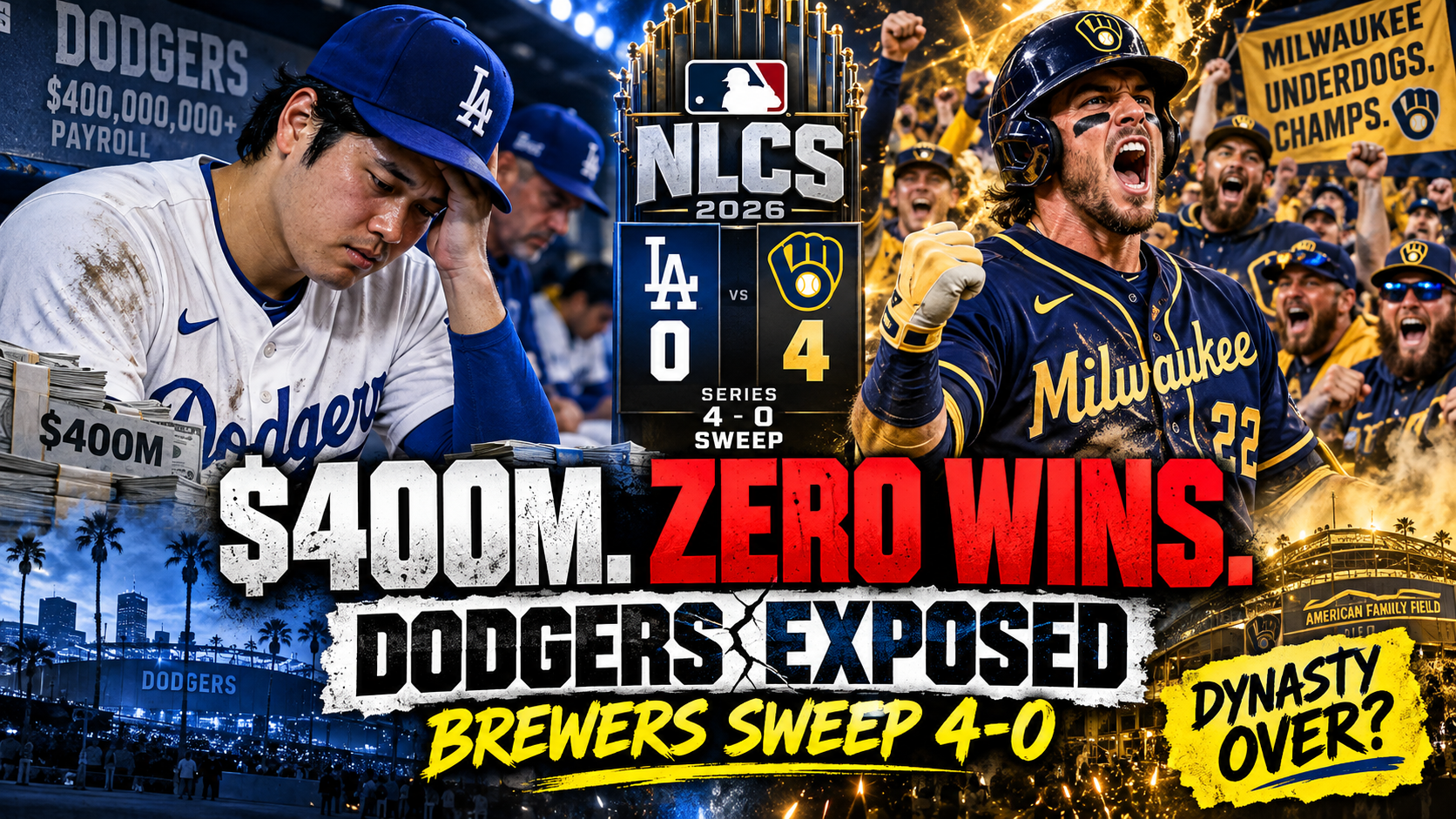
Dodgers Swept 4-0: $400M Payroll, Zero NLCS Wins
The Los Angeles Dodgers spent approximately $400 million on their 2026 player payroll. The Milwaukee Brewers spent roughly $131 million. Yet Milwaukee swept Los Angeles 4 to 0 in…
 13 min read
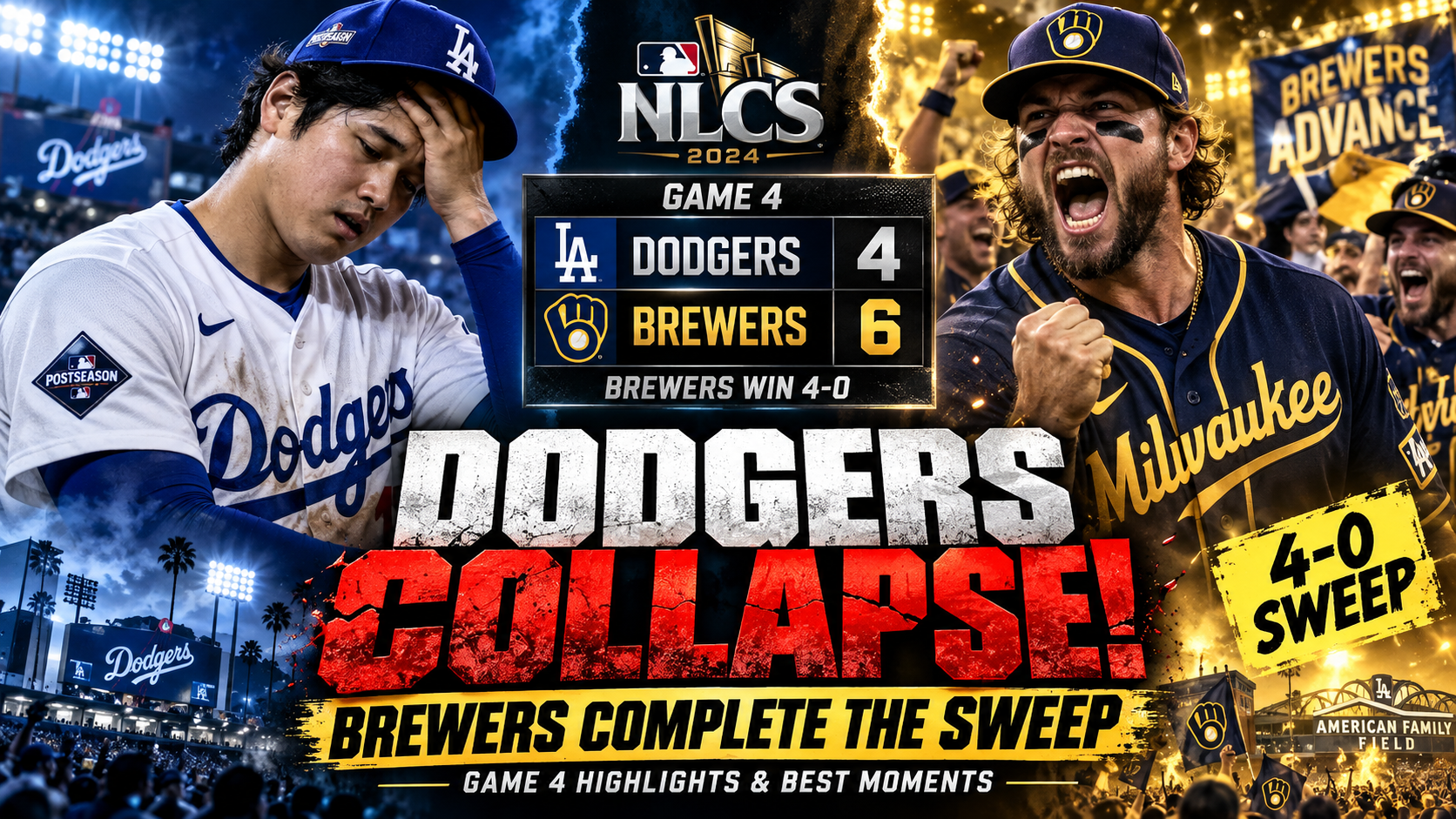
Brewers vs Dodgers Game 4 Highlights: LA's Collapse
The Milwaukee Brewers beat the Los Angeles Dodgers 6 to 4 in NLCS Game 4 on October 15, 2026, completing a four game sweep and advancing to their first World Series since 1982.…