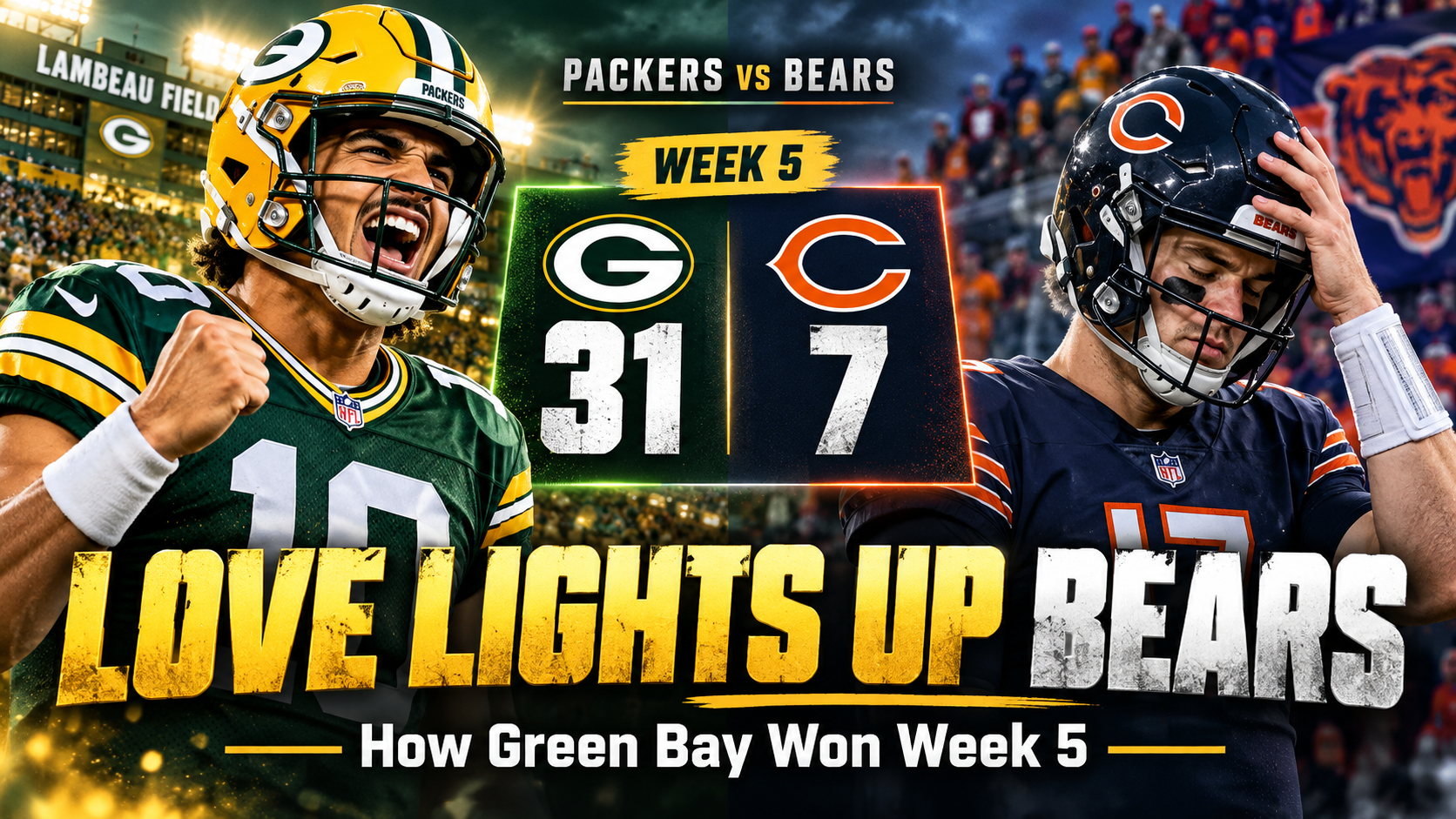
Packers vs Bears: What Changed for Jordan Love in Week 5?
The Green Bay Packers beat the Chicago Bears 31-7 in Week 5 of the 2026 NFL season. Jordan Love threw for 367 yards and two touchdowns, Christian Watson caught two long scores, and Green Bay forced five turnovers. But the most important development may have been how dramatically the Packers changed their approach to protecting Love and attacking downfield.
For the first month of the season, watching Green Bay's offense was often an exercise in frustration.
The offensive line struggled. Jordan Love faced consistent pressure. The running game barely existed. Even straightforward passing situations could become complicated when defenders reached the quarterback before routes had time to develop.
Then came Week 5.
Against the Chicago Bears, Love suddenly looked like a quarterback operating with complete control of the offense.
He completed 25 of 31 passes for 367 yards, two touchdowns and a career-high 137.5 passer rating. Green Bay won 31-7, improving to 3-2 and handing Chicago its second loss of the season.
The numbers were impressive. But the more interesting question is what actually changed.
The Packers didn't suddenly discover how to run the football. Instead, they found a way to protect Love long enough to attack Chicago's secondary, repeatedly creating explosive plays that the Bears couldn't defend.
That is the story worth examining.
The biggest numbers: Love completed six passes of at least 30 yards and threw for 258 yards on eight deep attempts. Chicago managed only 246 total offensive yards.
But those figures only tell part of the story.
1. Green Bay Finally Gave Jordan Love Time to Throw
A week earlier against Tampa Bay, the Packers had started to show signs of offensive line improvement after changing their starting combination.
Laken Tomlinson and Travis Glover entered the lineup, and the results suggested Green Bay might finally have found a more functional group up front.
Against Chicago, that progress became even more visible.
Love was not forced to abandon the pocket on every developing route. He had opportunities to let deeper concepts unfold and attack defenders farther downfield.
This distinction is important because protection is not simply about avoiding sacks.
A quarterback can avoid being sacked while still being forced into poor throws, rushed decisions or unnecessary checkdowns.
When protection improves, the entire range of an offense becomes available.
Receivers can run longer routes. Play action becomes more dangerous. Defenses have to respect throws behind their coverage rather than concentrating on the short and intermediate areas of the field.
For Green Bay, this was especially valuable against Chicago.
The Bears entered the game with a defense that had produced encouraging results, particularly on third down. But their aggressive approach created opportunities for receivers capable of winning vertically.
Love exploited those opportunities throughout the afternoon.
There is still an important limitation to this performance. One productive game does not prove Green Bay has permanently solved its offensive line problems.
The Bears provided a useful test, but future opponents will have different pass rushers, coverage structures and ways of challenging protection.
Still, Week 5 provided the clearest evidence so far that Green Bay's offensive line adjustments could make a meaningful difference.
2. Jordan Love Attacked the Bears Instead of Playing Around Their Pressure
Before this game, a reasonable expectation was that the Packers would try to compensate for their protection problems through quick passes.
Get the ball out early. Avoid long developing routes. Minimize obvious passing situations.
Matt LaFleur chose a more aggressive approach.
Rather than concentrating exclusively on short throws, Green Bay repeatedly attacked the deepest areas of Chicago's defense.
According to the NFL's Next Gen Stats analysis, Love completed six of eight deep passes for 258 yards and two touchdowns. His completion percentage on those attempts exceeded expectation by 43.8 percentage points.
That is an extraordinary level of efficiency on difficult throws.
It also helps explain why Chicago's defense looked so uncomfortable.
The Bears were not merely allowing receivers to catch underneath passes and accumulate yards after the catch. They were surrendering substantial gains before defenders could make a tackle.
Christian Watson was the most obvious beneficiary.
His first touchdown came on a 42-yard pass in the opening quarter, with Love finding him down the right sideline after play action.
The second was even more damaging.
Early in the third quarter, Green Bay faced third-and-22 after an offensive pass interference penalty erased an apparent touchdown to J. Michael Sturdivant.
Most offenses would be satisfied with recovering some field position in that situation.
Love instead threw a 53-yard touchdown to Watson.
That play was a demonstration of confidence, execution and a quarterback who trusted both his protection and his receiver.
It also exposed a major problem for Chicago.
A defense designed to force difficult third downs cannot consistently succeed if the offense can convert those situations with explosive throws over the secondary.
3. Christian Watson and Matthew Golden Created a Problem Chicago Could Not Solve
Much of the attention naturally goes to Love, but Green Bay's passing performance was not a one-man achievement.
Christian Watson finished with six catches for 143 yards and two touchdowns.
Matthew Golden added six receptions for 123 yards.
Together, they accounted for 266 receiving yards.
That combination presented Chicago with two different threats capable of stretching the defense.
Watson used his speed to create separation and attack the deeper portions of the field. Golden added another explosive option, repeatedly forcing defenders to account for vertical routes rather than concentrating on one receiver.
Tucker Kraft also contributed five catches for 64 yards, including a 46-yard gain in the third quarter.
That distribution matters.
When an offense has only one credible downfield threat, defensive coordinators can adjust coverage toward that player.
When multiple receivers are producing explosive gains, those adjustments become more difficult.
Chicago could not simply commit additional defenders to Watson without potentially creating opportunities for Golden or Kraft elsewhere.
The result was a passing attack that looked dramatically more dangerous than it had during the opening weeks.
It was also a reminder that Green Bay's receiving talent was never necessarily the central problem.
The greater issue was whether the offense could consistently give Love enough time to use it.
Against the Bears, the answer was yes.
4. Chicago's Defensive Aggression Became a Liability
Dennis Allen's defense had built part of its identity around pressure, aggressive coverage and forcing opposing quarterbacks into uncomfortable situations.
That approach can be highly effective when the pass rush arrives quickly.
It becomes far more dangerous when the quarterback has enough time to identify coverage and throw into open space downfield.
Against Green Bay, Chicago repeatedly allowed explosive completions.
The Bears permitted four passes of more than 40 yards, an especially damaging statistic for a defense trying to keep a divisional opponent under control.
The problem was not simply that Love threw the ball accurately.
Chicago frequently failed to prevent receivers from reaching dangerous areas of the field.
The 53-yard touchdown to Watson illustrated this perfectly.
Green Bay was facing third-and-22. The defense had already forced the offense into an unfavorable situation.
But instead of producing a stop, Chicago surrendered a touchdown.
That single play extended Green Bay's lead to 20-7 and significantly changed the second half.
It is tempting to describe the Bears' entire defensive approach as a failure. That would be an overreaction.
Aggressive coverage and pressure remain legitimate strategies, and the effectiveness of a defensive system cannot be judged from one game alone.
However, the Packers demonstrated the downside of that approach when protection holds up.
If the quarterback has time and receivers can threaten vertically, the margin for error becomes extremely small.
Chicago found itself repeatedly paying for those mistakes.
5. The Bears Could Not Recreate Their Running Game
Coming into Week 5, Chicago was averaging 196.3 rushing yards per game.
Against Green Bay, that number fell to 81.
The absence of Kyle Monangai mattered, but it would be too simplistic to attribute the entire decline to one missing player.
The Bears struggled to establish the same rhythm that had helped them control previous opponents.
Without a consistently productive rushing attack, the offense became more dependent on Tyson Bagent to execute in obvious passing situations.
That played directly into Green Bay's defensive strengths.
Bagent completed only 12 of 21 passes for 87 yards and threw two interceptions before being replaced by Case Keenum.
Chicago finished with 246 total yards and 17 first downs after averaging 433.5 yards and 29 first downs across its previous two victories.
That is not a minor statistical decline.
It represents an offense losing much of what had made it effective.
The Bears did produce one impressive possession.
In the second quarter, they assembled a 16-play, 78-yard touchdown drive that consumed more than nine minutes and ended with D'Andre Swift scoring from one yard out.
That drive demonstrated that Chicago could still move the football methodically.
The problem was that it couldn't reproduce that execution consistently.
For Ben Johnson, this may be the most concerning part of the game.
A team that relies heavily on rushing efficiency and carefully structured passing concepts cannot afford to become one-dimensional against a defense capable of producing pressure without constantly blitzing.
Once Chicago lost control of the early downs, its offensive limitations became increasingly obvious.
6. Tyson Bagent Struggled, but the Entire Offense Was Responsible
Quarterback performances are often judged too narrowly.
Bagent's numbers were poor, and his two interceptions were costly.
But blaming the entire defeat on Chicago's backup quarterback ignores the other issues around him.
The running game failed to establish control. The offensive line struggled to contain pressure. Receivers and quarterbacks were frequently unable to produce meaningful gains after completions.
Green Bay's defense also deserves considerable credit.
The Packers generated 31 quarterback pressures and forced five turnovers, including three interceptions and two recovered fumbles.
Xavier McKinney intercepted Bagent twice, while Ty'Ron Hopper added another interception against Keenum.
Dani Dennis-Sutton contributed a sack, a fumble recovery and several disruptive plays.
Those performances helped Green Bay control the game even when its offense was not on the field.
For Bagent, the contrast with his previous start was particularly sharp.
Against the Jets, Chicago had been able to combine a productive rushing attack with a structured passing game. Against Green Bay, those favorable conditions largely disappeared.
The result exposed how difficult the offense becomes when the quarterback must repeatedly compensate for negative plays and limited production on the ground.
Caleb Williams' absence also matters in evaluating Chicago's longer-term outlook.
Bagent should be judged on his performance, but the Bears' offensive identity with their starting quarterback may be different.
This defeat was therefore an indictment of Sunday's execution rather than definitive proof that Chicago's entire offensive philosophy is flawed.
7. The Five Turnovers Made a Comeback Almost Impossible
Green Bay did not merely produce explosive plays on offense.
It also repeatedly gave itself additional opportunities through defensive takeaways.
The Bears committed five turnovers. The Packers committed none.
Green Bay turned those mistakes into 15 points.
One of the most important came early.
After Watson's opening touchdown, Javon Bullard tipped a Bagent pass that McKinney intercepted.
That possession eventually ended with MarShawn Lloyd's first career rushing touchdown, putting the Packers ahead 14-0.
Later, McKinney's second interception set up another Lloyd touchdown early in the fourth quarter.
The defensive performance meant Chicago was forced to play from behind while continuously losing opportunities to establish offensive rhythm.
There is an important distinction here.
Turnovers can make a final score appear more one-sided than the underlying performance.
In this case, however, they reinforced advantages Green Bay had already established through its passing game and defensive pressure.
The Packers did not win solely because Chicago gave away the football.
They consistently created situations in which those mistakes became more likely.
8. The Packers Still Have Problems They Cannot Ignore
Winning 31-7 against a divisional rival is an excellent result.
It does not mean every problem has disappeared.
Green Bay's rushing attack remains an obvious concern.
MarShawn Lloyd scored two touchdowns but finished with just 31 rushing yards on 10 carries.
The touchdowns were valuable, especially after the Packers had failed to score a rushing touchdown through their first four games.
But the limited yardage shows that Green Bay did not suddenly establish a dominant ground game.
The offense remained heavily dependent on Love's passing production.
That can work when the quarterback is protected and receivers consistently win downfield.
It becomes more complicated against defenses capable of preventing explosive plays.
Special teams were another issue.
Rookie kicker Trey Smack missed two field goals and an extra point.
Those misses did not alter the outcome against Chicago, but they could become much more costly in a close divisional game or during the postseason.
Green Bay also needs to monitor its defensive health, with Javon Hargrave leaving the game injured.
The victory was convincing. The roster is not without weaknesses.
9. What This Performance Means for the Packers Going Forward
Green Bay entered Week 5 looking like a team that was still trying to establish a reliable offensive identity.
Against Chicago, the Packers showed what that identity might become.
A more functional offensive line allowed Love to attack downfield.
Watson and Golden provided explosive production.
Kraft added another receiving threat.
And a disruptive defense repeatedly prevented Chicago from generating momentum.
The central question now is whether that formula is sustainable.
Love will not complete deep passes at this rate every week. Opponents will adjust their coverage. Better pass rushers may expose protection weaknesses that Chicago could not consistently exploit.
But the Packers no longer have to imagine what their offense might look like with improved blocking.
They have seen it happen.
For Chicago, the questions are different.
Can the Bears restore their rushing production? Can their secondary prevent so many explosive completions? And how much does the offense improve when Caleb Williams returns?
Those answers will matter much more than one disappointing afternoon in Green Bay.
Final Takeaway: The Packers Found a More Dangerous Version of Their Offense
The final score was 31-7, but the biggest story was not simply that Green Bay dominated Chicago.
It was how the Packers did it.
For weeks, their offensive line had restricted what Jordan Love could realistically accomplish.
Against the Bears, improved protection allowed Green Bay to unlock a much more aggressive passing attack.
Love exploited Chicago's secondary. Watson and Golden repeatedly won downfield. And the Packers' defense ensured that the Bears never had the chance to respond consistently.
The five takeaways and explosive touchdowns made this a comfortable victory.
But the potential improvement in pass protection could be far more important for Green Bay's season.
If the Packers can consistently give Love time to throw, their offense has the weapons to become one of the more difficult units in the NFC to defend.
If they cannot, Week 5 may prove to be an impressive exception rather than a genuine turning point.
That is what makes the next few games so important.
Frequently Asked Questions
Who won Packers vs Bears in Week 5 of the 2026 NFL season?
The Green Bay Packers defeated the Chicago Bears 31-7 on October 11, 2026, at Lambeau Field. Both teams finished the game with 3-2 records.
How many passing yards did Jordan Love have against the Bears?
Jordan Love completed 25 of 31 passes for 367 yards and two touchdowns, finishing with a 137.5 passer rating.
How many touchdowns did Christian Watson score?
Watson caught two touchdown passes, including a 42-yard score in the first quarter and a 53-yard touchdown early in the third quarter.
Why did the Bears lose to the Packers?
Chicago struggled to protect the quarterback, generated only 81 rushing yards, allowed multiple explosive passes and committed five turnovers. Green Bay controlled the game through its passing attack and defensive takeaways.
How did Tyson Bagent play against Green Bay?
Bagent completed 12 of 21 passes for 87 yards with two interceptions. He was replaced by Case Keenum in the fourth quarter.
Did the Packers improve their running game?
Green Bay scored its first two rushing touchdowns of the season through MarShawn Lloyd, but the ground attack remained inconsistent. Lloyd finished with 31 rushing yards on 10 carries.
What was the biggest turning point in Packers vs Bears?
One of the defining moments came early in the third quarter when Jordan Love connected with Christian Watson for a 53-yard touchdown on third-and-22, extending Green Bay's lead to 20-7.
Done reading? Your turn.
Think you know Football? Settle it.
AI builds a fresh quiz on any topic, you play it against the community and climb the leaderboard. Free, no download.
Play free in 10 seconds → 3 min read
What Is AI Sports Trivia and How Does It Work?
AI sports trivia is a quiz where the questions are written by AI instead of pulled from a fixed list. Here is how it works, why the questions rarely repeat, and how to play NFL trivia free on Spontyx.
 13 min read
NFL Week 5 2026 Exposed the League's Most Overrated Teams
NFL Week 5 delivered a few uncomfortable truths. The Philadelphia Eagles fell to 2-3, the Los Angeles Chargers remained winless, the Green Bay Packers destroyed the Chicago Bears,…
 13 min read
Dodgers Swept 4-0: $400M Payroll, Zero NLCS Wins
The Los Angeles Dodgers spent approximately $400 million on their 2026 player payroll. The Milwaukee Brewers spent roughly $131 million. Yet Milwaukee swept Los Angeles 4 to 0 in…