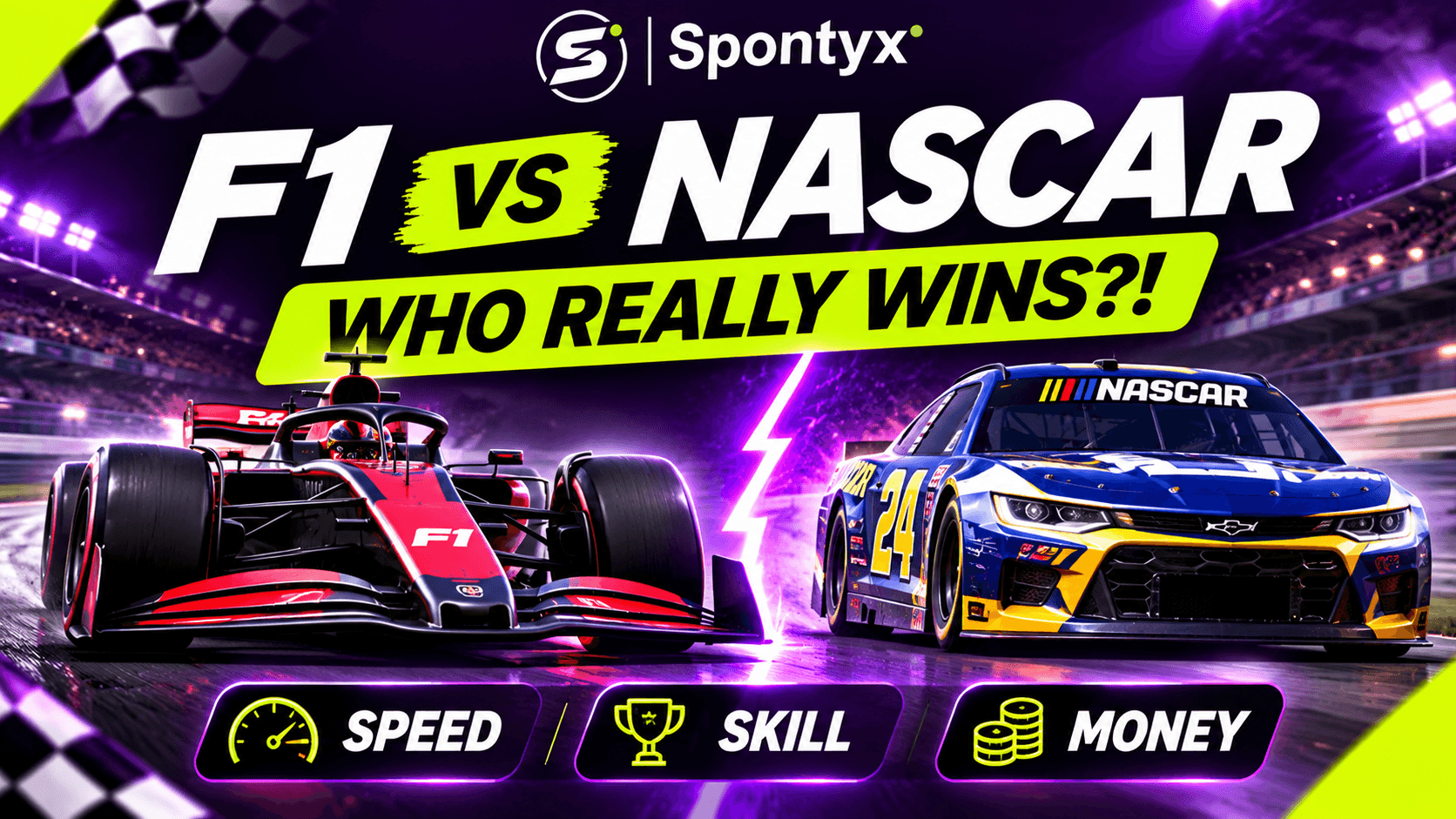
F1 vs NASCAR: The Ultimate Speed, Skill and Popularity Showdown
F1 vs NASCAR: The Ultimate Speed, Skill and Popularity Showdown
Put a Formula 1 car next to a NASCAR Cup Series car.
One looks like a fighter jet with wheels. The other looks like a road car that has spent its entire life in the gym.
Both are incredibly fast.
Both require elite drivers.
And both have fans who are absolutely convinced their favorite racing series is better.
But here's the question that starts arguments across the motorsport world:
Is Formula 1 actually faster than NASCAR? And does faster mean harder?
The answer is more interesting than you might expect.
A modern F1 car is generally much quicker around a conventional road course. NASCAR drivers, meanwhile, can race inches apart at extraordinary speeds on steeply banked ovals, often with dozens of cars fighting for position.
The two championships reward different skills.
And in 2026, the comparison is particularly interesting because both series have changed important elements of their competition.
Let's settle the biggest debates using facts instead of fan loyalty.
F1 vs NASCAR: speed, technology, money, racing difficulty, popularity and the ultimate winner.
And at the end, there's a ten-question motorsport trivia challenge to see whether you know these two series as well as you think.
F1 vs NASCAR: Quick Comparison
Here are the biggest differences between Formula 1 and the NASCAR Cup Series in 2026.
| Category | Formula 1 | NASCAR Cup Series |
|---|---|---|
| Type of car | Open-wheel, single-seat racing car | Full-bodied, stock-car-style racer |
| Main racing locations | Road and street circuits | Mostly ovals, plus road and street courses |
| Engine | Turbocharged V6 hybrid | Naturally aspirated V8 |
| Electrical power | Major part of total output | No comparable race-propulsion hybrid system |
| Aerodynamics | Advanced downforce and active aero | Track-specific aerodynamic packages |
| Vehicle mass | Much lighter | Substantially heavier |
| Road-course lap speed | Generally faster | Generally slower |
| Racing style | Technical precision, energy management and strategy | Drafting, traffic management, close racing and strategy |
| Championship | Season-long points competition | Modified Chase format in 2026 |
| Geographic audience | International | Primarily United States |
| Typical pit-stop tasks | Tire changes and adjustments | Tire changes, refueling and adjustments |
The short answer: F1 wins the conventional road-course performance comparison. NASCAR offers a distinctly different challenge built around racing in dense packs, managing traffic and handling heavier cars.
Neither comparison proves that one series requires more talent.
1. F1 vs NASCAR Speed: Which Car Is Actually Faster?
Winner: Formula 1 on a conventional road course.
This is the question most people search first.
And the answer depends on what you mean by fast.
There are at least three different ways to measure racing-car speed:
- Maximum speed on a straight.
- Average speed over a lap.
- Time required to complete the same circuit.
These measurements do not always produce the same comparison.
F1 Cars: Designed for Extraordinary Cornering Speed
Formula 1 cars combine lightweight construction, powerful hybrid systems, sophisticated suspension and advanced aerodynamics.
Their most impressive advantage isn't simply how fast they travel on a straight.
It's how much speed they can carry through corners.
Large aerodynamic forces help push the tires into the track, allowing drivers to corner and brake at levels that ordinary road cars cannot approach.
The 2026 F1 regulations introduced smaller cars, revised aerodynamics and much more emphasis on electrical power.
That makes Formula 1 an even more interesting engineering comparison.
NASCAR Cars: Built for High-Speed Racing in Traffic
NASCAR Cup cars are heavier and use powerful V8 engines.
On large banked ovals such as Daytona and Talladega, aerodynamic drafting allows cars to race at sustained high speeds while running extremely close together.
That creates a different challenge from navigating a tight street circuit in Monaco.
A NASCAR driver may spend long periods surrounded by cars, adjusting to airflow changes, turbulent conditions and tiny gaps.
What About Top Speed?
You will find internet comparisons claiming that NASCAR cars are faster because one historical stock car reached an extraordinary speed on an oval.
You'll also find articles claiming every Formula 1 car is faster in every possible situation.
Neither statement is a complete comparison.
Maximum speed depends on the season, circuit, gearing, aerodynamic setup, drafting, power regulations and even whether a figure comes from a race, qualifying session or historical record attempt.
A historic NASCAR speed record is not the same as the top speed achieved by a contemporary NASCAR Cup car under current race regulations.
The same goes for comparing an older F1 car with a new 2026 Formula 1 machine.
Verdict: Formula 1 is generally faster around road courses because of its superior cornering, braking and acceleration performance. Comparing isolated top-speed records can be misleading.
2. F1 vs NASCAR Cars: The Engineering Difference
Winner for technological sophistication: Formula 1.
Winner for purpose-built stock-car racing: NASCAR.
The most obvious difference is their appearance.
An F1 car has exposed wheels, a low body and complex aerodynamic surfaces.
A NASCAR Cup car has an enclosed body resembling a production-car silhouette.
But the most interesting differences are underneath.
Formula 1: High-Tech Hybrid Engineering
In 2026, Formula 1 introduced a new power-unit formula with a much larger electrical contribution.
The championship moved toward an approximately even division between internal-combustion and electrical power.
F1 also introduced active aerodynamic systems that change the car's aerodynamic configuration during a lap.
These systems make energy management and aerodynamic efficiency even more important.
Unlike a conventional road car, nearly every part of an F1 machine is designed around maximizing performance within the technical regulations.
NASCAR: V8 Power and Shared Components
NASCAR Cup cars use naturally aspirated V8 engines.
The modern Next Gen car, introduced in 2022, brought major design changes including independent rear suspension, larger wheels, a sequential transmission and many common components.
For 2026, NASCAR increased its target horsepower to 750 at road courses and oval tracks shorter than 1.5 miles.
Other tracks use different engine and aerodynamic packages.
That distinction matters: NASCAR horsepower is not one universal number across every event.
Which Car Would Win on a Road Course?
If both cars ran a comparable road course under suitable conditions, the Formula 1 car would generally have a substantial advantage.
The F1 machine is built to maximize lap time through braking, acceleration, aerodynamic performance and cornering.
The NASCAR car is optimized for a different set of regulations and race conditions.
But putting both cars on a steeply banked superspeedway wouldn't create an equally meaningful comparison.
F1 cars are not designed to compete in NASCAR-style pack racing on those ovals.
The fastest car depends on the test. The more specialized car depends on the discipline.
3. F1 vs NASCAR Drivers: Which Is Harder?
Verdict: No objective overall winner.
This might be the most controversial question in the entire comparison.
Formula 1 fans often point to technical driving precision and the extreme physical forces experienced by drivers.
NASCAR fans counter with long races, close-quarters battles, unpredictable traffic and the skill required to keep a heavy car under control.
Both arguments have merit.
Why Formula 1 Is So Difficult
F1 drivers need exceptional braking precision, car control and high-speed cornering ability.
They must understand tire behavior, energy deployment, racing lines and constantly changing grip conditions.
On a technical street circuit, a small mistake can end a race immediately.
The 2026 regulations also put additional responsibility on drivers to manage electrical energy and new aerodynamic systems effectively.
And because F1 cars are so quick through corners, the physical and cognitive demands can be enormous.
Why NASCAR Is So Difficult
NASCAR drivers frequently compete in dense traffic.
On superspeedways, a driver can be surrounded by several cars traveling at very high speed.
A small change in drafting, positioning or momentum can have major consequences.
Drivers also have to deal with changing handling characteristics over long runs, track banking, tire wear, restarts and close contact.
And because NASCAR races on different types of circuits, drivers must adapt their approach.
Short-track racing, road courses and large superspeedways require different techniques.
Could an F1 Champion Easily Win in NASCAR?
Not necessarily.
A world-class Formula 1 driver could bring exceptional braking, precision and racing instincts to NASCAR.
But that doesn't mean they would immediately master drafting, oval racecraft and stock-car handling.
The reverse is equally true.
A NASCAR champion would face an enormous adjustment to Formula 1's aerodynamic demands, hybrid systems and technical road courses.
Juan Pablo Montoya competed in both Formula 1 and NASCAR, demonstrating that crossing disciplines is possible.
But success in one form of racing doesn't guarantee success in the other.
The better question isn't which drivers are more talented. It's which skills each competition rewards.
4. F1 vs NASCAR Popularity: Which Has More Fans?
Winner globally: Formula 1.
Formula 1 has a much broader international audience.
It competes across multiple continents and has a fanbase spanning Europe, Asia, the Americas and other regions.
According to Formula 1's own corporate reporting, its global fanbase exceeded 830 million people during 2026.
That is an estimate of global fandom, not the number of people watching each race live.
NASCAR has a different geographic profile.
Its fanbase is concentrated much more heavily in the United States, where the championship has a long racing tradition.
What About Popularity in America?
The comparison is closer in the United States.
NASCAR has a deeply established domestic fanbase.
Formula 1, however, has expanded its American presence through races, media exposure and a growing international audience.
A 2025 third-party search-interest analysis published by Hyperset estimated higher average monthly U.S. search demand for NASCAR than Formula 1, while finding much higher global search interest for Formula 1.
That analysis measures search behavior, not unique fans or television viewers.
A particularly important distinction is that Google searches, TV ratings, social followers and self-identified fans are four different metrics.
You cannot combine them into a single popularity ranking without defining the methodology.
Verdict: Formula 1 has greater global reach. NASCAR remains especially influential in the United States.
5. F1 vs NASCAR Money: Which Is More Expensive?
Winner for engineering complexity and development spending: Formula 1.
But comparing the economics of both championships is not as straightforward as comparing car speed.
F1 teams operate large international engineering organizations.
They develop highly specialized chassis, aerodynamics and performance systems within tightly controlled regulations.
The championship also has financial regulations that restrict certain categories of spending.
NASCAR operates under a different commercial structure.
The Next Gen system uses more standardized components, and teams compete with vehicles built around common technical requirements.
However, a NASCAR team's budget still includes expensive personnel, equipment, travel, cars, engines and racing operations.
Do F1 Drivers Earn More Than NASCAR Drivers?
The highest-paid Formula 1 drivers are generally associated with very large contracts.
But there is a major problem with online salary comparisons.
Neither championship publishes one complete, standardized database covering every driver's salary, bonuses, personal sponsorship revenue and commercial arrangements.
Many salary figures published online are estimates.
A fair comparison would need to distinguish:
- Guaranteed driver salary.
- Performance bonuses.
- Team-paid compensation.
- Personal sponsorship agreements.
- Endorsements and other commercial income.
Without consistent public data, claiming that every Formula 1 driver earns more than every NASCAR driver would be unjustified.
Verdict: Formula 1 is more engineering-intensive, but exact team budgets and driver salaries require careful, like-for-like comparisons.
6. F1 vs NASCAR Racing: Which Is More Exciting?
Winner: Depends on what you want from racing.
Let's imagine two very different Sundays.
In Formula 1, the race is taking place on a narrow street circuit.
The drivers are approaching corners at incredible speed.
Track position matters.
Pit-stop strategy can change the entire contest.
A single mistake may decide the result.
Now imagine NASCAR at Daytona.
Cars are packed together.
Drivers are drafting, switching lanes and fighting for position at high speed.
A restart can completely change the running order.
Both races are exciting, but for different reasons.
Why Fans Love Formula 1
Formula 1 appeals strongly to viewers interested in engineering, technical strategy, racecraft and global competition.
The battle between teams is partly a contest of design and development.
That can produce fascinating strategic stories even when on-track overtaking is limited.
Why Fans Love NASCAR
NASCAR frequently emphasizes head-to-head racing, drafting, restarts and track-position battles.
Its events can produce repeated changes in momentum.
The championship's varied oval formats also create different racing challenges throughout the season.
Is NASCAR Just Driving in Circles?
No.
That criticism overlooks how banked ovals work.
Drivers must manage tire wear, airflow, traffic, line selection, suspension balance and the behavior of the car in long corners.
An oval may look simple from above.
Driving competitively on one is not.
Likewise, dismissing Formula 1 as nothing more than expensive technology ignores the precision required to control those cars at racing speed.
Both championships are easy to underestimate if you've only watched one of them.
7. F1 vs NASCAR Pit Stops: Who Is Faster?
Winner for pure tire-changing speed: Formula 1.
An F1 pit crew can change four tires in only a few seconds.
The work is highly specialized, and the objective is to minimize stationary time while following the sporting regulations.
NASCAR pit stops usually take longer because they can involve tire changes and refueling.
The cars, equipment and crew procedures are different.
The modern NASCAR Next Gen car also uses a single center-lock wheel fastener rather than the older five-lug-nut arrangement.
However, simply comparing the time a car is stationary does not tell the complete story.
NASCAR and Formula 1 pit-stop strategies depend on different fueling rules, tire requirements, race formats and safety procedures.
F1 wins on the speed of a four-tire change. NASCAR pit stops involve a different combination of tasks.
8. F1 vs NASCAR Championships: What Changed in 2026?
This is one of the most important differences in the current season.
Formula 1: Season-Long Points Competition
Formula 1 awards championship points throughout the season.
The Drivers' Championship rewards the driver who accumulates the most points across the applicable events.
The Constructors' Championship recognizes the teams.
Performance throughout the season matters, with no NASCAR-style postseason Chase.
NASCAR: The Chase Returned in 2026
This is where outdated articles can be misleading.
For 2026, NASCAR changed its championship format.
The Cup Series returned to a modernized version of The Chase.
Sixteen drivers qualify for the final ten-race championship phase.
Unlike the previous elimination-style playoff system, the revised format does not feature round-by-round eliminations.
Drivers continue accumulating points across those ten races.
The change was intended to put more emphasis on consistent performance while retaining a dramatic championship conclusion.
Verdict: Formula 1 uses a season-long points championship. NASCAR's 2026 Chase creates a distinct final ten-race title competition.
9. Which Is Better for New Fans: F1 or NASCAR?
If you have never followed either series, choose the one that matches the kind of sporting experience you enjoy.
| If you enjoy… | Start with |
|---|---|
| Advanced technology and engineering | F1 |
| Racing on international circuits | F1 |
| Strategy involving energy and aerodynamics | F1 |
| Large packs and drafting battles | NASCAR |
| Traditional American stock-car racing | NASCAR |
| Different styles of oval racing | NASCAR |
| High-pressure championship decisions | Either |
| Exceptional driver skill | Either |
| Motorsport history and rivalries | Either |
You don't actually have to choose one.
Watching both gives you a broader appreciation for motorsport.
And understanding the differences makes the debate much more interesting.
F1 vs NASCAR Trivia Quiz: Can You Score 10/10?
You've just read the comparison.
Now let's see what you remember.
Ten questions. Ten points. No looking back at the article.
Question 1
Which championship uses a turbocharged V6 hybrid power unit in 2026?
A. NASCAR Cup Series B. Formula 1 C. Both D. Neither
Question 2
Which series primarily races full-bodied, stock-car-style vehicles?
A. Formula 1 B. NASCAR Cup Series C. Both D. Neither
Question 3
Which series introduced significantly greater electrical power contribution under its 2026 regulations?
A. NASCAR B. Formula 1 C. Both equally D. Neither
Question 4
Which NASCAR circuit is famous for its 2.66-mile oval?
A. Martinsville B. Bristol C. Talladega D. Sonoma
Question 5
Which series returned to a modified Chase championship format in 2026?
A. Formula 1 B. NASCAR C. Both D. Neither
Question 6
Which former Formula 1 driver also competed in the NASCAR Cup Series?
A. Juan Pablo Montoya B. Ayrton Senna C. Jim Clark D. Juan Manuel Fangio
Question 7
Which racing format is most closely associated with aerodynamic drafting in large packs?
A. Formula 1 street circuits B. NASCAR superspeedway racing C. Rally stages D. Hillclimb racing
Question 8
Which series introduced active aerodynamic configurations for its 2026 cars?
A. Formula 1 B. NASCAR Cup Series C. Both D. Neither
Question 9
Which racing series has a broader global fanbase?
A. NASCAR Cup Series B. Formula 1 C. They have identical global audiences D. There is no way to compare their geographic reach
Question 10
Which statement is most accurate?
A. NASCAR drivers race only on ovals B. F1 cars are always slower in corners C. Both championships require different but highly developed racing skills D. NASCAR Cup cars use the same power units as Formula 1
F1 vs NASCAR Quiz Answers
| # | Correct answer | Explanation |
|---|---|---|
| 1 | B. Formula 1 | F1 uses hybrid V6 power units with a major electric contribution. |
| 2 | B. NASCAR | Cup cars have enclosed, production-inspired bodywork. |
| 3 | B. Formula 1 | The 2026 regulations expanded the electrical part of F1's hybrid system. |
| 4 | C. Talladega | Talladega Superspeedway is a 2.66-mile oval. |
| 5 | B. NASCAR | The Chase returned with a new final ten-race structure in 2026. |
| 6 | A. Juan Pablo Montoya | Montoya competed in both F1 and NASCAR. |
| 7 | B. NASCAR superspeedway racing | Drafting and pack dynamics play major roles at Daytona and Talladega. |
| 8 | A. Formula 1 | Active aerodynamics are part of the 2026 F1 regulations. |
| 9 | B. Formula 1 | F1 has a much wider international fanbase. |
| 10 | C. Both require different skills | Each series tests drivers through its own technical and competitive demands. |
How Did You Score?
| Score | Your level |
|---|---|
| 0-3 | Motorsport Rookie |
| 4-6 | Casual Racing Fan |
| 7-8 | Racing Expert |
| 9 | Motorsport Historian |
| 10/10 | Racing Encyclopedia |
These categories are just for fun.
But here's a tougher challenge.
Could you answer ten new questions about Formula 1 and NASCAR without knowing what was coming?
Spontyx offers free daily sports trivia, while AI Pro users can request custom quiz topics through AI Arena.
For example, you could create a quiz about Formula 1 world champions, NASCAR history or legendary drivers from both competitions.
F1 vs NASCAR: Frequently Asked Questions
Is F1 faster than NASCAR?
Formula 1 cars are generally much quicker around conventional road courses because of their lower mass, sophisticated aerodynamics, braking and cornering performance. Straight-line speed comparisons depend on the circuit, car setup and regulations.
Is NASCAR harder than Formula 1?
There is no objective overall winner. Formula 1 demands exceptional precision, aerodynamic understanding and technical road-course driving. NASCAR emphasizes different skills, including drafting, traffic management and oval racecraft.
Which is more popular, F1 or NASCAR?
Formula 1 has greater worldwide popularity and geographic reach. NASCAR has a particularly strong traditional fanbase in the United States.
Do NASCAR cars go faster than F1 cars?
Not generally when comparing contemporary cars on conventional road courses. NASCAR's high-speed oval racing and historical speed records can make direct top-speed comparisons misleading.
Do F1 drivers make more money than NASCAR drivers?
Top F1 salaries are generally very high, but precise comparisons are difficult because contracts, bonuses and sponsorship income are not disclosed consistently across both series.
Does NASCAR only race on oval tracks?
No. NASCAR primarily races on ovals but also competes on road courses and street circuits.
Does F1 race on ovals?
Modern Formula 1 races on road and street circuits, not NASCAR-style oval tracks.
Which cars are heavier, F1 or NASCAR?
NASCAR Cup cars are substantially heavier than modern Formula 1 cars.
Does NASCAR use hybrid engines like F1?
No. The 2026 NASCAR Cup Series continues to use naturally aspirated V8 engines, while F1 uses advanced hybrid power units.
Why are Formula 1 pit stops faster?
F1 pit stops are optimized for extremely rapid tire changes. NASCAR stops may also involve refueling, creating a different service process.
How does NASCAR decide its champion in 2026?
The NASCAR Cup Series uses a modified Chase format, with sixteen qualified drivers competing for the championship across the final ten races without round-by-round eliminations.
Can F1 drivers race in NASCAR?
Yes. Juan Pablo Montoya is a prominent example of a driver who competed in both championships. However, switching between the disciplines requires considerable adaptation.
Can I play a Formula 1 or NASCAR trivia quiz online?
Yes. Spontyx AI Arena supports custom sports quiz topics, including motorsport subjects, through AI Pro. Free daily sports trivia is also available separately.
Final Verdict: F1 vs NASCAR - Who Really Wins?
So, which championship is better?
If you care most about lap time, Formula 1 has the advantage on conventional road courses.
If you love high-speed drafting, close pack racing and oval battles, NASCAR offers something Formula 1 cannot replicate directly.
If you prefer high-tech engineering and global competition, F1 is an obvious attraction.
If you enjoy American racing tradition and a wide variety of oval challenges, NASCAR is worth watching.
And if you want to know which drivers are more talented?
That argument probably isn't ending anytime soon.
The most interesting thing about F1 vs NASCAR is that both championships can be incredibly difficult for completely different reasons.
Now that you know the differences, put your motorsport knowledge to the test.
Because understanding the sport is one thing.
Proving what you know is another.
Done reading? Your turn.
Think you know Formula 1? Settle it.
- Free, no card
- New SCOUT every day
- Every sport
- Compete on the boards
GTA 6 Stats Explained: Strength, Cardio, Focus
GTA 6 has just three trainable stats: Strength for Health, Cardio for Stamina and Focus for slow-motion aiming. Here is how to raise each one, and whether they fade if you stop.
Nov 22, 2026
What Sports Can You Play in GTA 6? Every Sport, and Is Tennis Playable?
GTA 6 is full of sport: golf, basketball, pool, fishing, hunting, the gym and water sports like scuba. But not tennis, which is scenery only. Here is the full playable lineup.
Nov 22, 2026
How to Work Out in GTA 6: Gym Guide
Working out in GTA 6 is a real system. Here is the free home gym, every machine, how the trigger controls work, the recovery cooldown, and how to stop your gains from fading.
Nov 22, 2026
Comments
0